


Last Will and Testament
A last will and testament is a legal document that allows individuals to specify how their assets will be distributed and provide directions to loved ones upon their death.
Select a state


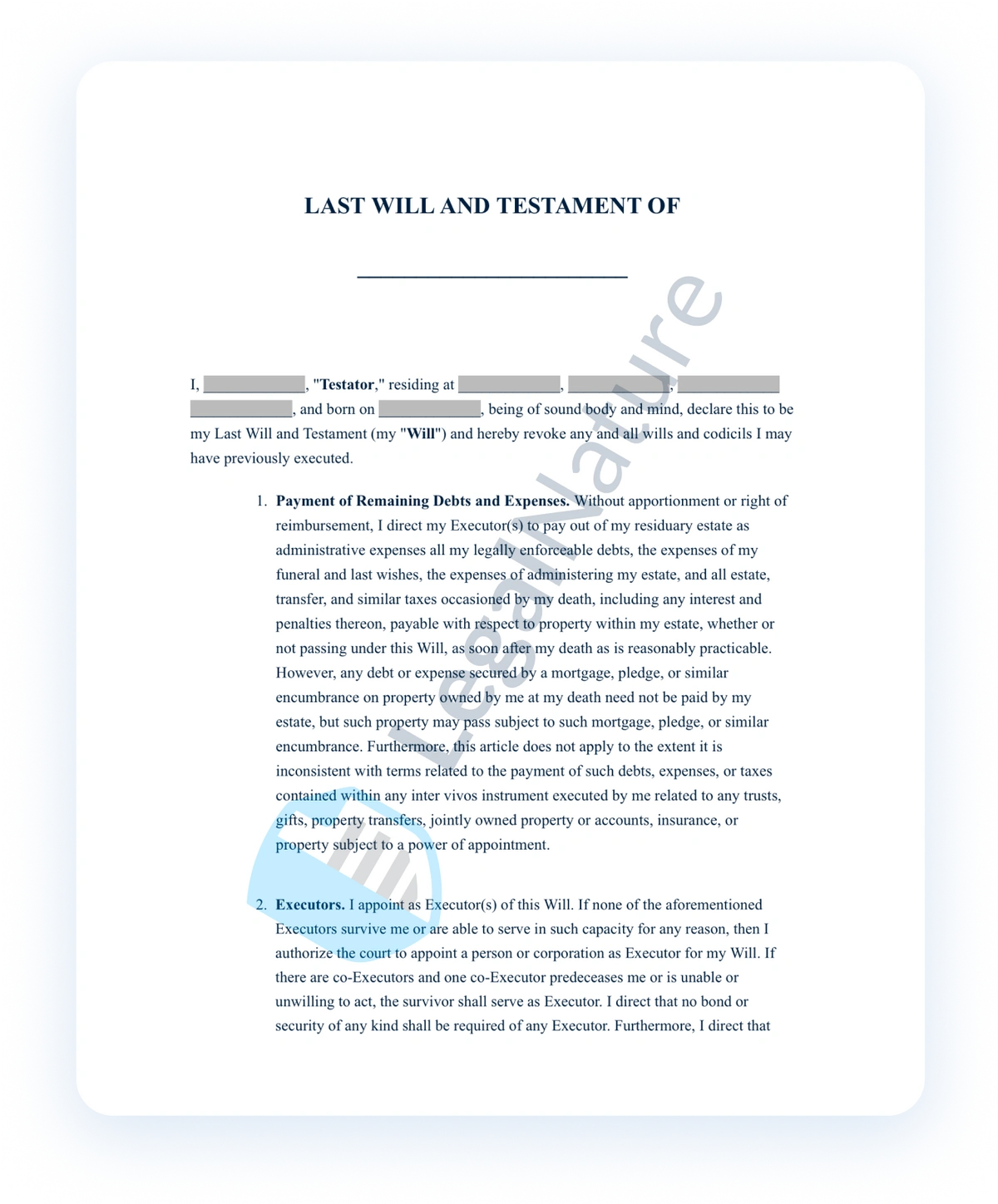
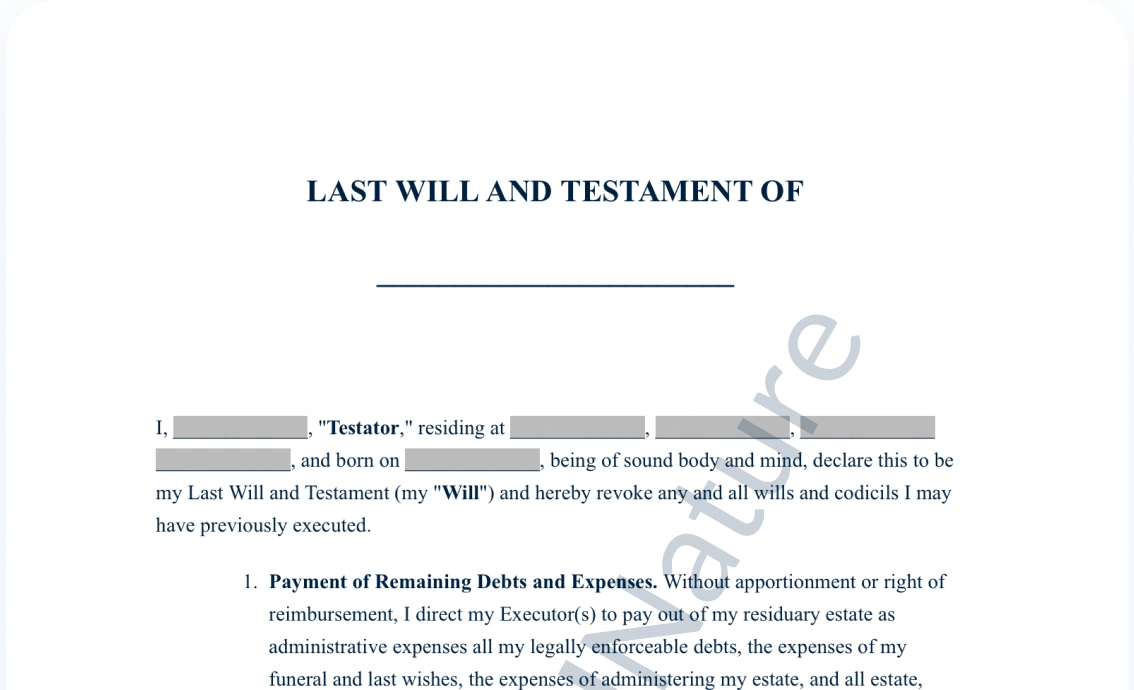
What is a last will and testament?
A last will and testament is a legal document that outlines the final wishes of the testator, or creator, of the will. A last will and testament is an essential tool in estate planning which allows you to:
- specify how your property and possessions should be distributed after death,
- name guardians for minor children or dependents,
- designate an executor to manage the estate,
- make charitable donations or gifts, and
- provide instructions for your funeral or memorial service.
Without a valid will, your estate may be subject to intestacy laws, potentially leading to unintended beneficiaries and family disputes. Creating a will ensures that your hard-earned assets are distributed according to your desires, providing peace of mind for you and your loved ones.
Use the estate planning document which best suits your needs
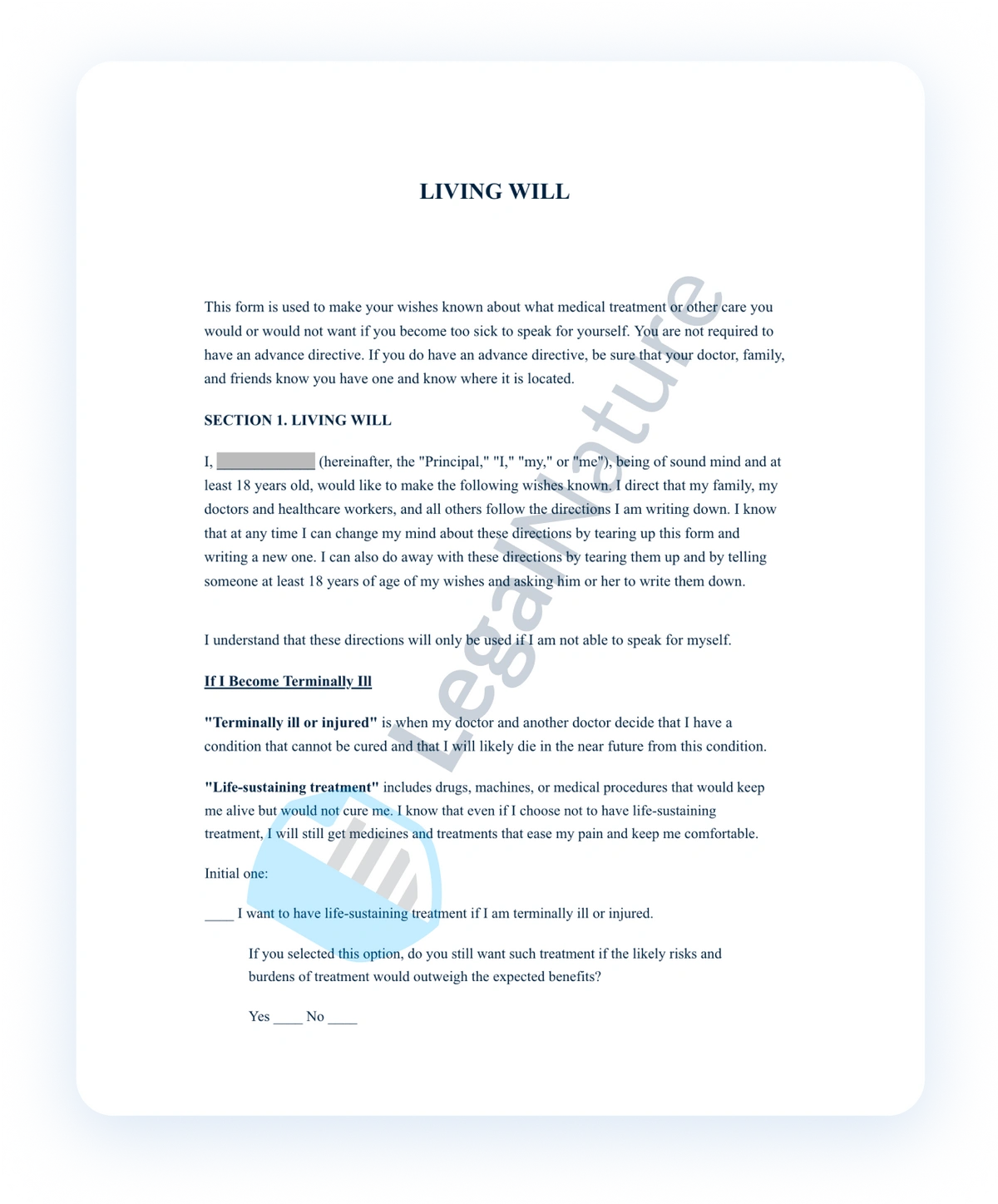
Living Will A legal document that outlines your medical treatment preferences if you become incapacitated. It specifies decisions about life-sustaining procedures, pain management, and end-of-life care.
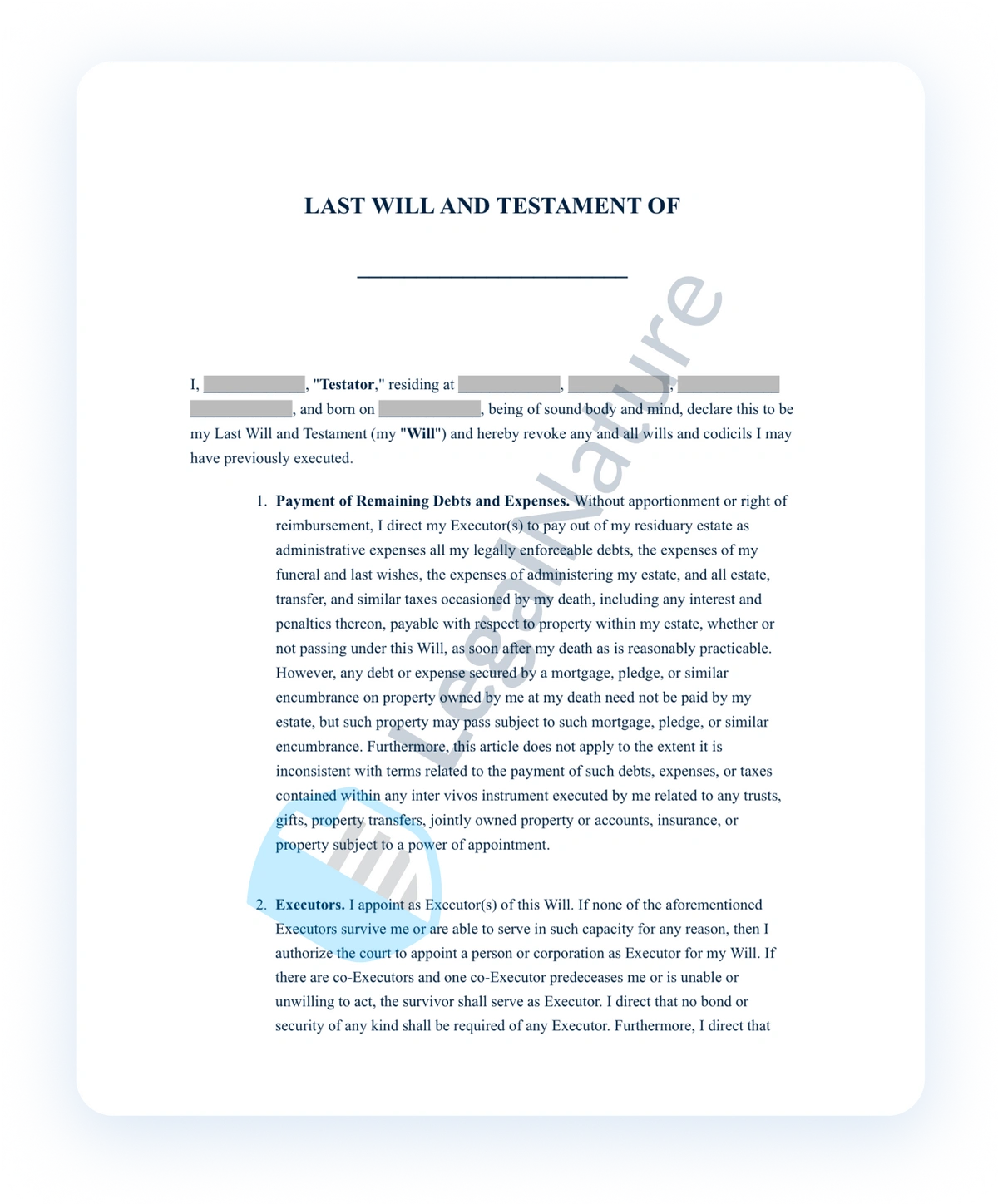
Pour-Over Will An estate planning tool that works in conjunction with a living trust. This legal document ensures that any assets not already transferred to your trust during your lifetime are automatically "poured over" into the trust upon your death.
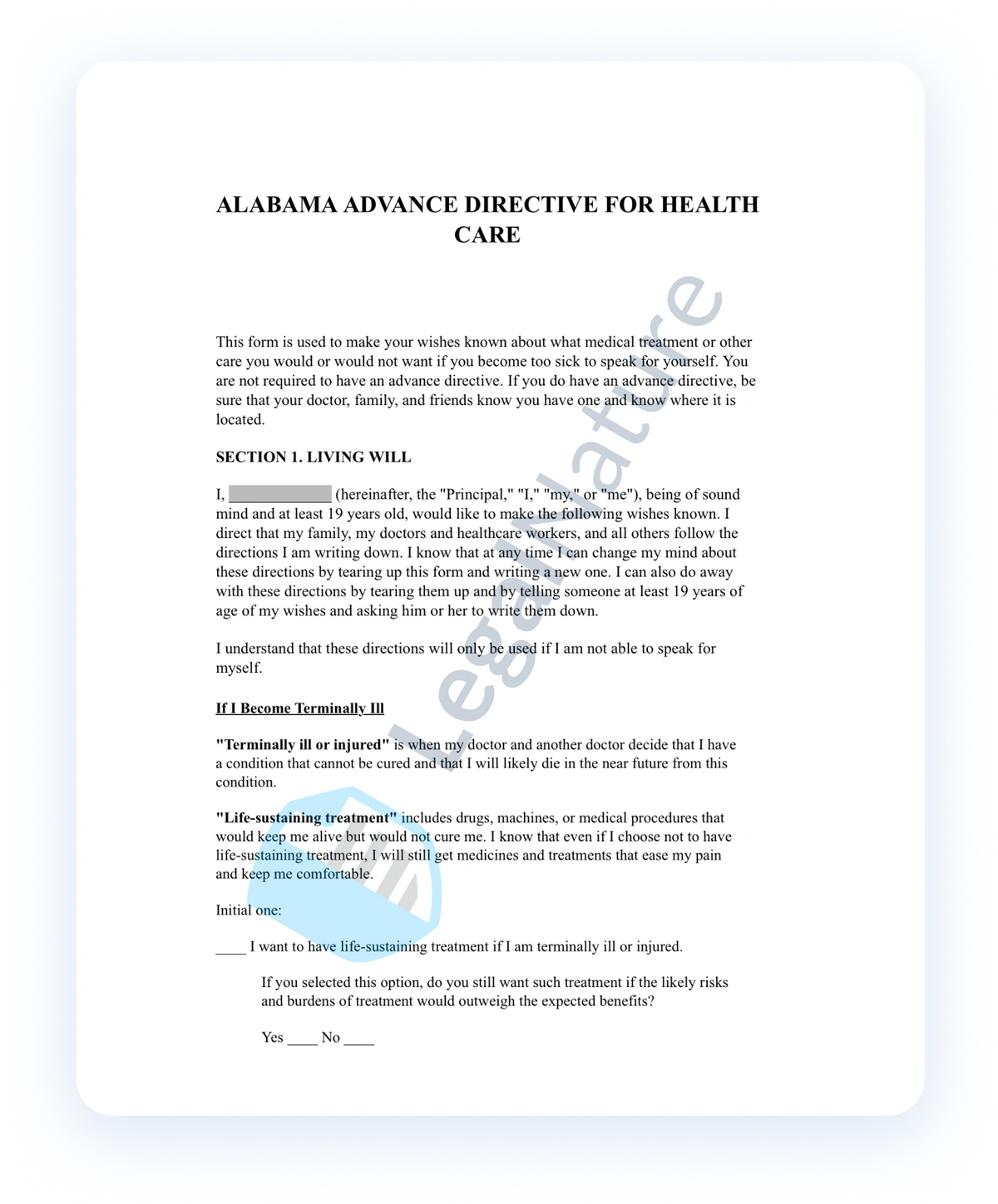
Advance Healthcare Directive Similar to a living will, an advance healthcare directive outlines your medical treatment preferences if you become incapacitated. This legal document is often the combination of a living will and healthcare power of attorney to ensure your wishes are respected in the event you cannot communicate due to a medical emergency.
Create a last will and testament in your state
When to create a last will and testament
A last will and testament is a crucial document for ensuring your assets and property are handled according to your wishes after you die. Here are several key situations when you should prioritize creating or updating your will:
- Entering Adulthood: Once you turn 18, it is wise to create a basic will, especially if you have any assets or digital property.
- Marriage or Divorce: These life changes necessitate updating your will to reflect your new marital status and beneficiaries.
- Having Children: Designate guardians for your minor children and ensure their financial security through your will.
- Acquiring Significant Assets: As you accumulate wealth or property, a will becomes essential to dictate their distribution.
- Starting a Business: Protect your business interests and outline succession plans in your will.
- Approaching Retirement: Review and update your will to align with your retirement plans and estate goals.
- After Major Life Events: Significant changes like relocations, deaths in the family, or health diagnoses warrant will updates.
- Regularly (Every 3-5 Years): Even without major life changes, periodic reviews ensure your will remains current and valid.
Dying without a will, also known as "intestate," may lead to a lengthy probate process and the unintended or unwanted distribution of your assets. Implementing a will safeguards you and your family's interests. A basic will is generally sufficient to protect a testator's assets, but complicated estates may require more complicated estate planning.
Steps to create your last will and testament
Gather Information and Inventory
As you complete your last will and testament, you will need to provide certain relevant information. This includes the name and address of each beneficiary and any assets you would like to distribute to them. You should also create an inventory of your assets and property with their approximate values.
Complete Our Short Questionnaire
Use the information you collected to complete the last will and testament. We make this easy by guiding you each step of the way and helping you to customize your document to match your specific needs.
Review and Sign
It is always important to read your document thoroughly to ensure it matches your needs and is free of errors and omissions. Some states may require that the will is signed and witnessed by at least two individuals in the testator's presence.
Why create a last will and testament?
Wills are an important planning tool for those who want to make sure that their wishes are formally and legally documented by specifying how their estate should be managed and distributed after they die. Those with one or more minor children should also consider creating a will to make sure that they have identified contingency plans for the custody of their children in case both parents die prematurely. Wills are also beneficial for the following:
- Helping you to decide how to distribute your assets post-mortem
- Ensuring your loved ones' interests are protected
- Communicating your last wishes
- Choosing a trustworthy administrator for your estate

Why choose LegalNature?
LegalNature offers the guidance to navigate the nuances of will creation across all 50 states and the District of Columbia. LegalNature offers a 30-day money-back guarantee. If you're not happy, then we’re not happy. Give us a call and let us help.
Last will and testament guide
The primary role of a last will and testament is to identify how assets and liabilities will be handled after the testator—the person creating the will—dies. After payment of the debts, taxes, and expenses of administering the estate, the remaining assets that pass through the will are distributed according to its terms.
Wills also serve to identify who will be in charge of handling the estate and take care of administrative tasks like safeguarding assets, paying final expenses, settling and paying valid debts, navigating probate court, and filing and meeting any final tax obligations. All this occurs before any distributions to named beneficiaries and heirs are made. The person in charge of handling the estate is called different things in different states, but most commonly that person is known as the personal representative or executor of the estate.
A will can also nominate a guardian to have physical custody of minor children if a child’s parents die before he or she reaches the age of 18.
What is included in a will?
There are several types of wills, but the main components across the types remain the same, including:
- Personal Property and Assets: How and to whom your personal assets, such as accounts or belongings are distributed.
- Real Property: The disposition of any homes, buildings, or structures that you own.
- Guardianship: Testators with minor children can and should appoint guardians for their minor children or legal dependents.
- Executor: The representative of your estate in charge of ensuring that the wishes set forth in your will are followed.
Differences between a will and a trust
A trust is effective as soon as it is created and executed, while the provisions of a will take effect upon your death. The administration of a will requires the court probate process while trusts may be carried out on their own. Wills become public record after they are submitted to probate, while trust details remain private. Trusts have the flexibility to include conditions on asset distribution and timing, but wills are less flexible, with distribution occurring at the close of probate.
Types of wills
While a simple will is often sufficient to handle a person's estate, there are several types of wills that may be utilized to account for larger or more complicated estates, or other alternative dispositions.
- Pour-Over Wills: A trust takes effect while the creator is still alive. In the instance that a trust does not contain all of a creator's estate property, a pour-over will is often utilized to "pour over" the remainder of the testator's property into the trust upon the testator's death.
- Holographic Wills: Written and signed by hand, these wills are often made in emergency or unexpected situations. Unfortunately, these wills are not recognized as valid in many states, highlighting the importance of creating legally sufficient estate planning documents through professional services, such as LegalNature.
- Living Will: This outlines your medical treatment preferences if you become incapacitated. It specifies decisions about life-sustaining procedures, pain management, and end-of-life care. By creating a living will, you ensure your healthcare wishes are respected and reduce the burden on your loved ones during difficult times.
- Will Trust: Establishes a testamentary trust upon the testator's death which must pass through probate since the operative document is still a will. These are often used to care for dependents or minor children and may set forth a plan for the care of the beneficiaries of the testamentary trust.
Other common will questions
Can I write my own will?
While there is no law against writing your own will, it is not recommended. Each state has its own distinct requirements that must be followed for a will to be legally sufficient. You do not need an attorney to write your will, but utilizing a professional service is highly suggested in order to avoid having an unenforceable document.
What happens if I do not have a will?
Passing away without a will is called dying "intestate," and dying intestate leaves your estate to be distributed according to state law instead of by your wishes. In most states, this passes your estate directly to your spouse, regardless of whether you are still together or separated.
Which items should not be included in my will?
Some properties should not be included in a will because they will be validly distributed by other means. Examples of these properties include the following:
- Jointly held property: These will often pass automatically to the surviving joint owner(s).
- Life insurance proceeds: Life insurance plans include beneficiaries that will receive the proceeds outside of the probate process.
- Retirement accounts: As with a life insurance policy, beneficiaries should be designated with the account so that the funds pass outside of the probate process.
How often should my will be updated?
It is often recommended that you review your will every 3 to 5 years to be sure the distribution of your estate is still in line with your wishes. It is also important to update your will after any major life events, such as marriage, separation, or divorce, death of a beneficiary, purchase or sale of significant real property, or moving to a new state or country. Regular, periodic reviews or updates to your will ensures that your estate distribution remains in line with your wishes.
When can my will be contested?
Courts will generally do their best to uphold and maintain a deceased's final wishes; however, the legal sufficiency or validity of a will can be contested under certain circumstances. First, only individuals with legal standing can contest a will, including current beneficiaries, previously disinherited beneficiaries, or individuals who would inherit under intestacy if the will were invalidated. The most common reasons to challenge the validity of a will include the following:
- Lack of testamentary capacity: The testator lacked sufficient mental competence when creating the will.
- Undue influence: Someone exerted pressure on the testator to alter the will's contents.
- Fraud or forgery: Deception was involved in the will creation or execution.
- Improper execution: The testator failed to meet the legal formalities required by state law when executing the will document.
- Lack of knowledge or approval: The testator did not understand or approve the will's contents.
Frequently asked questions
Do I need a will?
Every adult needs to do at least some estate planning, even while young and healthy. In many cases, a will is a key part of an estate plan. Specifically, wills are an important planning tool for those who want to make sure that their wishes are formally and legally documented by specifying how their estate should be managed and distributed after they die. Those with one or more minor children should also consider creating a will to make sure that they have identified contingency plans for the custody of their children in case both parents die prematurely.
Do I need an attorney to write my will?
Creating your own will is legally permissible, but not advisable. Each state enforces unique legal requirements for valid wills. While an attorney is not mandatory, professional assistance is strongly recommended to ensure your will is enforceable and accurately reflects your wishes. Using expert services can help you navigate state-specific laws, avoid costly mistakes, and provide peace of mind that your final wishes will be honored
Can I disinherit someone in my will?
Wills are governed by state law. In most states, you can disinherit a child, but you cannot completely disinherit a spouse. One of the reasons someone may choose to create a will is to document his or her wishes for distributing assets unevenly among named beneficiaries or completely disinheriting someone altogether. If you choose to disinherit a relative, it is a good idea to ensure that your will includes language confirming that any omissions are intentional and are not the result of a mistake. This can help avoid litigation brought by someone who felt they should have inherited a share of your estate.
Can a will include guardianship provisions for my minor children?
Yes. One of the primary reasons many young parents decide to create a will is to plan for the worst-case scenario by nominating someone to have physical custody of their minor child or children in the event of the parents’ premature deaths. If you decide to nominate a guardian in your will, it is recommended that you discuss your wishes with the person you want to name ahead of time. Becoming a legal guardian for someone else’s child is a big responsibility. You may also want to name one or more successor guardians if the first named person declines or is not able to serve in that role for your children.
Is my will valid if I move out of state?
Yes; all states are required to recognize and uphold wills from other states. However, local state laws may affect how your estate is treated. For example, property may be treated differently when moving from a community property state to a common law property state. If moving abroad, there are no guarantees that your last will and testament will remain valid. When moving, it is recommended that you seek advice on the impact it will have on your estate plan.
Can a will be used to pass life insurance or retirement assets?
When you purchase a life insurance policy or annuity contract, or when you open a 401(k), IRA, or other retirement account, you will generally be asked to designate one or more beneficiaries for the policy or account. Your named beneficiaries will inherit by contract, which means that those assets will not pass through your last will and testament. In some cases, people want to make sure all of their assets pass according to the terms of their will. In those cases, naming “my estate” as the beneficiary will accomplish that goal. However, because of the complexities surrounding tax laws when retirement dollars flow through a will, you may wish to consult a tax advisor or accountant before designating your estate as your retirement plan beneficiary.
Can I change my will?
You are free to update your will at any time. In fact, it is highly recommended that you review your will periodically to ensure that it still echoes your wishes and reflects the contents of your estate. There are two ways to change your will. Firstly, for minor changes, you can make a document called a codicil. This document will state the changes you wish to make and will be attached to your will. Alternatively, you can make a new will if you need to make more extensive updates. It is always a good idea to destroy all copies of any old wills and to notify the relevant people.
Where should I keep my will?
In the event your will needs to go through a probate court proceeding, having the original document may make that process easier for your nominated personal representative or executor. Therefore, it is important that he or she is able to access the document. Your will is an important legal document, so keep it in a safe place. This can be a safety deposit box if someone else knows it is there and has authorization to access the box at the bank or other financial institution. Keeping your executed will in a home safe, fire-proof box, or another place inside your home can also be effective, as long as your personal representative or executor knows where to find it. Generally, there is no need to file or register your will with any state or county government authority, although some jurisdictions allow people to file their wills for safekeeping for only a nominal fee.
Create your last will and testament in minutes
Complete our form
;fill-opacity:1;'/%3e%3cpath%20fill-rule='evenodd'%20clip-rule='evenodd'%20d='M7.17816%205.46484C8.48591%205.46484%209.81742%206.23165%2011.1727%207.76529C10.8517%208.08628%2010.6467%208.28838%2010.5575%208.3716C10.4683%208.45482%2010.2514%208.6391%209.90659%208.92442C9.56182%209.20975%209.28244%209.40591%209.06844%209.51291C8.85445%209.6199%208.5721%209.73285%208.22138%209.85173C7.87067%209.97062%207.52293%2010.0301%207.17816%2010.0301C6.75017%2010.0301%206.35785%209.97656%206.00119%209.86957C5.64453%209.76257%205.28788%209.5783%204.93122%209.31675C4.57456%209.0552%204.29518%208.83229%204.09307%208.64801C3.89096%208.46374%203.58781%208.16355%203.18359%207.74745C3.95636%206.97469%204.64291%206.40107%205.24329%206.02658C5.84367%205.65209%206.48862%205.46484%207.17816%205.46484ZM7.17816%209.37024C7.61804%209.37024%207.9955%209.20975%208.31055%208.88876C8.6256%208.56776%208.78312%208.18733%208.78312%207.74745C8.78312%207.30757%208.6256%206.92714%208.31055%206.60615C7.9955%206.28516%207.61804%206.12466%207.17816%206.12466C6.73828%206.12466%206.36082%206.28516%206.04577%206.60615C5.73072%206.92714%205.5732%207.30757%205.5732%207.74745C5.5732%208.18733%205.73072%208.56776%206.04577%208.88876C6.36082%209.20975%206.73828%209.37024%207.17816%209.37024ZM7.17816%207.1768C7.17816%207.34324%207.23166%207.47996%207.33865%207.58696C7.44565%207.69395%207.58237%207.74745%207.74881%207.74745C7.8677%207.74745%207.98658%207.70584%208.10547%207.62262V7.74745C8.10547%208.009%208.01631%208.23191%207.83798%208.41619C7.65965%208.60046%207.43971%208.6926%207.17816%208.6926C6.91661%208.6926%206.69667%208.60046%206.51834%208.41619C6.34001%208.23191%206.25085%208.009%206.25085%207.74745C6.25085%207.4859%206.34001%207.26299%206.51834%207.07872C6.69667%206.89444%206.91661%206.80231%207.17816%206.80231H7.32082C7.22571%206.9212%207.17816%207.04603%207.17816%207.1768Z'%20fill='white'%20style='fill:white;fill-opacity:1;'/%3e%3c/svg%3e)
Preview and download your document
;fill-opacity:1;'/%3e%3cg%20clip-path='url(%23clip0_10486_8655)'%3e%3cpath%20d='M10.8931%205.49519C10.8004%205.45343%2010.6879%205.48908%2010.6427%205.57565L10.4595%205.92398L10.3128%205.85879L10.5058%205.49212L10.5069%205.48906C10.508%205.48703%2010.5091%205.48397%2010.5103%205.48194C10.54%205.4137%2010.5743%205.33324%2010.5864%205.24258C10.6239%204.97267%2010.5125%204.68749%2010.2874%204.47869C10.0733%204.28007%209.74562%204.16804%209.43445%204.18534C9.36934%204.18942%209.29984%204.20062%209.22812%204.21998C9.11446%204.25053%209.00302%204.30349%208.8982%204.37785C8.82316%204.4308%208.71833%204.52146%208.64661%204.64877L8.64551%204.65184L8.64441%204.65387L7.9603%205.95657C7.95698%205.96166%207.95369%205.96675%207.95037%205.97286C7.94705%205.97795%207.94485%205.98406%207.94265%205.99017L6.17057%209.36151C6.14408%209.41244%206.13085%209.46947%206.13305%209.5265V9.52752L6.17277%2010.6143C6.17718%2010.7202%206.22022%2010.819%206.29194%2010.8964L6.18712%2011.0919C6.14078%2011.1775%206.1794%2011.2814%206.27207%2011.3242C6.29856%2011.3364%206.32724%2011.3425%206.35483%2011.3425C6.42435%2011.3425%206.49056%2011.3069%206.52366%2011.2458L6.62516%2011.0553C6.64061%2011.0563%206.65495%2011.0573%206.6704%2011.0573C6.77412%2011.0573%206.87673%2011.0278%206.9628%2010.9687L7.91392%2010.325C7.93379%2010.3118%207.95254%2010.2955%207.96909%2010.2792C7.97241%2010.2761%207.97461%2010.2731%207.97793%2010.27C7.9989%2010.2476%208.01655%2010.2222%208.0309%2010.1957L10.1483%206.16942L10.2951%206.23461L9.35169%208.02823C9.30645%208.11379%209.34507%208.21768%209.43886%208.25943C9.46535%208.27165%209.49293%208.27674%209.52052%208.27674C9.59004%208.27674%209.65735%208.24109%209.68935%208.17896L10.7023%206.25293C10.7078%206.24581%2010.7133%206.23766%2010.7177%206.2295C10.7222%206.22134%2010.7244%206.21422%2010.7277%206.20606L10.9804%205.72533C11.0255%205.64082%2010.9858%205.53694%2010.8931%205.49519ZM6.73994%2010.6907C6.70574%2010.7131%206.6627%2010.7182%206.62408%2010.7049C6.61857%2010.7019%206.61305%2010.6988%206.60643%2010.6958C6.60312%2010.6948%206.60092%2010.6937%206.5976%2010.6927C6.5656%2010.6723%206.54575%2010.6398%206.54463%2010.6041L6.51814%209.89623C6.76641%2010.0745%207.05219%2010.2028%207.35673%2010.2741L6.73994%2010.6907Z'%20fill='white'%20style='fill:white;fill-opacity:1;'/%3e%3cpath%20d='M5.59896%2011.03C5.55151%2011.029%205.49634%2011.03%205.43897%2011.03C5.13885%2011.0331%204.57941%2011.0382%204.40067%2010.8538C4.36976%2010.8222%204.33005%2010.7652%204.3444%2010.647C4.38634%2010.314%204.58935%209.96362%204.76811%209.65499L4.79789%209.60305C4.85638%209.50221%204.91707%209.40036%204.97664%209.30056C5.14766%209.01537%205.32421%208.72%205.46433%208.40935C5.56806%208.18018%205.62542%207.96426%205.63536%207.7697C5.64859%207.50897%205.57799%207.28183%205.42571%207.09441C5.24365%206.86932%204.97774%206.70431%204.61361%206.58821C4.31128%206.49145%203.97806%206.44154%203.68455%206.39672C3.55215%206.37635%203.42635%206.35801%203.3105%206.33561C3.20899%206.31626%203.10969%206.37737%203.08982%206.47108C3.06885%206.56478%203.13505%206.65645%203.23658%206.67479C3.36015%206.69822%203.48926%206.71756%203.62497%206.73793C4.18219%206.82248%204.81444%206.91719%205.1256%207.30118C5.30986%207.52832%205.30766%207.85628%205.11788%208.2759C4.98547%208.56925%204.81444%208.85545%204.64783%209.13248C4.58825%209.23231%204.52646%209.33619%204.46687%209.43905L4.43709%209.48998C4.2418%209.82609%204.02111%2010.207%203.97146%2010.6053C3.9472%2010.7957%203.99795%2010.9567%204.12152%2011.084C4.38082%2011.3498%204.8939%2011.3763%205.29223%2011.3763C5.34408%2011.3763%205.39485%2011.3763%205.44229%2011.3753C5.49855%2011.3753%205.55043%2011.3743%205.59456%2011.3753C5.59566%2011.3753%205.59566%2011.3753%205.59676%2011.3753C5.69939%2011.3753%205.78324%2011.2989%205.78434%2011.2041C5.78544%2011.1105%205.70266%2011.031%205.59896%2011.03Z'%20fill='white'%20style='fill:white;fill-opacity:1;'/%3e%3c/g%3e%3cdefs%3e%3cclipPath%20id='clip0_10486_8655'%3e%3crect%20width='7.91304'%20height='7.30435'%20fill='white'%20style='fill:white;fill-opacity:1;'%20transform='translate(3.08594%204.12891)'/%3e%3c/clipPath%3e%3c/defs%3e%3c/svg%3e)
Review and sign your document
