


Quit Claim Deed
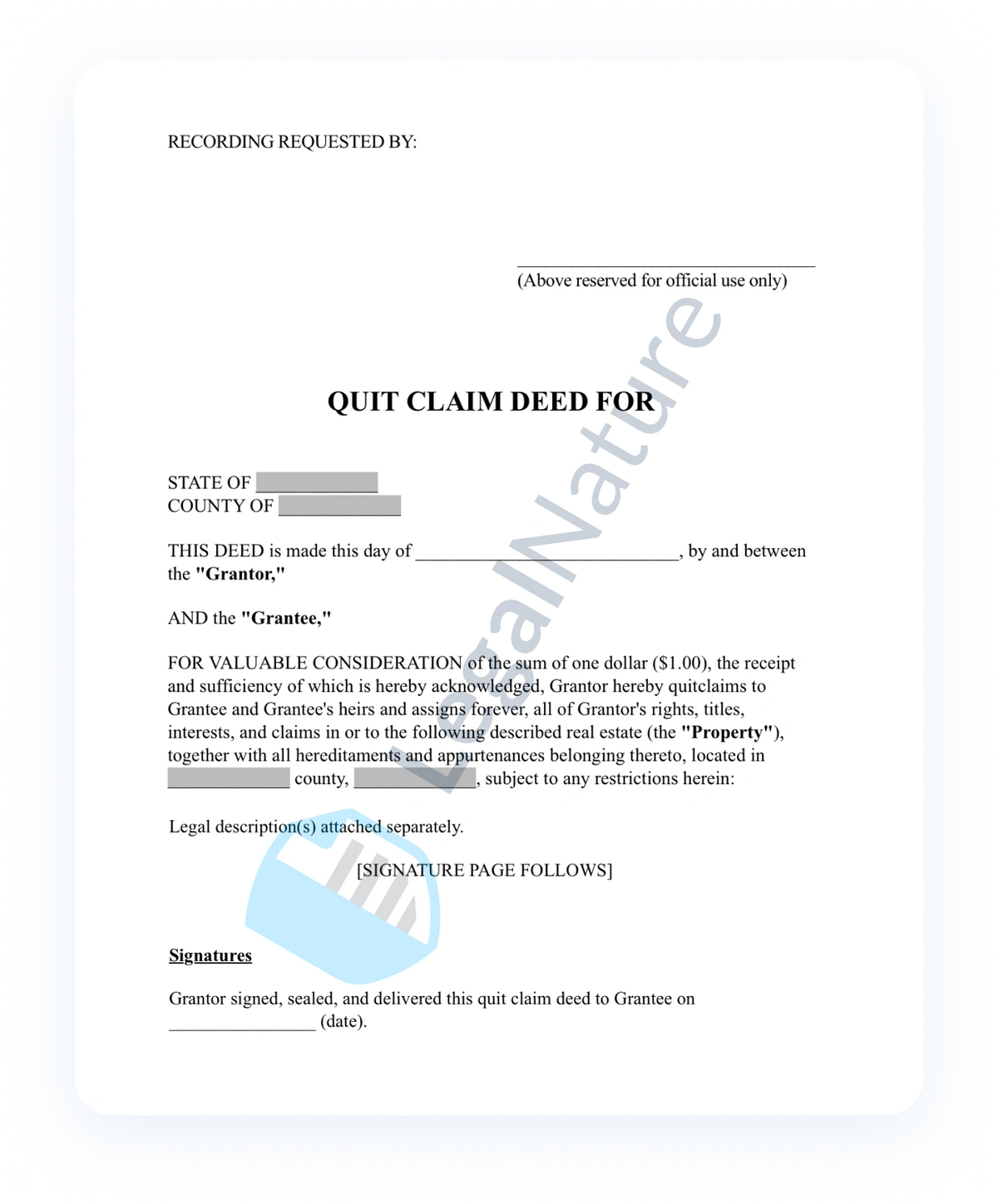
A quit claim deed is a common deed used to transfer property from one person to another.
Select a state


What is a quit claim deed?
A quit claim deed is a legal document used for transferring ownership of real estate from one party (the grantor) to another (the grantee) without providing any guarantees about the property’s title or the grantor’s ownership rights. The person giving the property, known as the grantor, and the person receiving the property, known as the grantee, must be accurately identified in the legal documents to ensure a valid property transfer. A quitclaim deed transfers ownership by conveying the grantor's interest in the property to the grantee.
A quitclaim deed works by allowing the grantor to quickly transfer property interests to the grantee, but it does not guarantee that the grantor’s interest is valid or that the title is clear. This quitclaim deed offers a way to facilitate property transfer, often used in situations such as family transfers, adding or removing a spouse, or clarifying ownership in real estate transactions.
Unlike other types of deeds, a quit claim deed offers no warranties or assurances regarding the validity of the grantor’s interest in the property, making this type of property transfer common in non-traditional real estate transactions.
Use the correct property deed for you
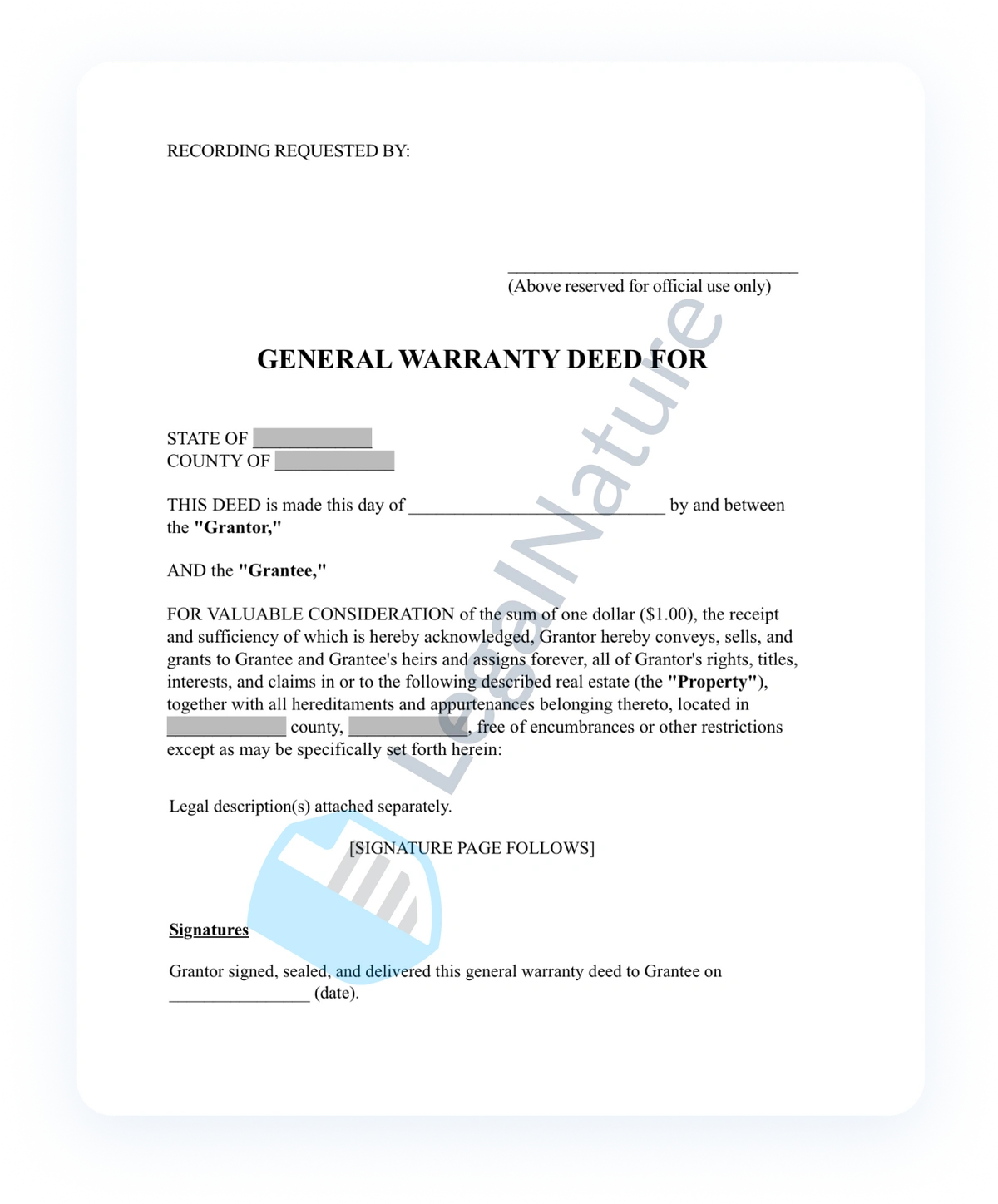
General Warranty Deed This type of deed provides comprehensive guarantees about the property's title and the seller's right to transfer it.
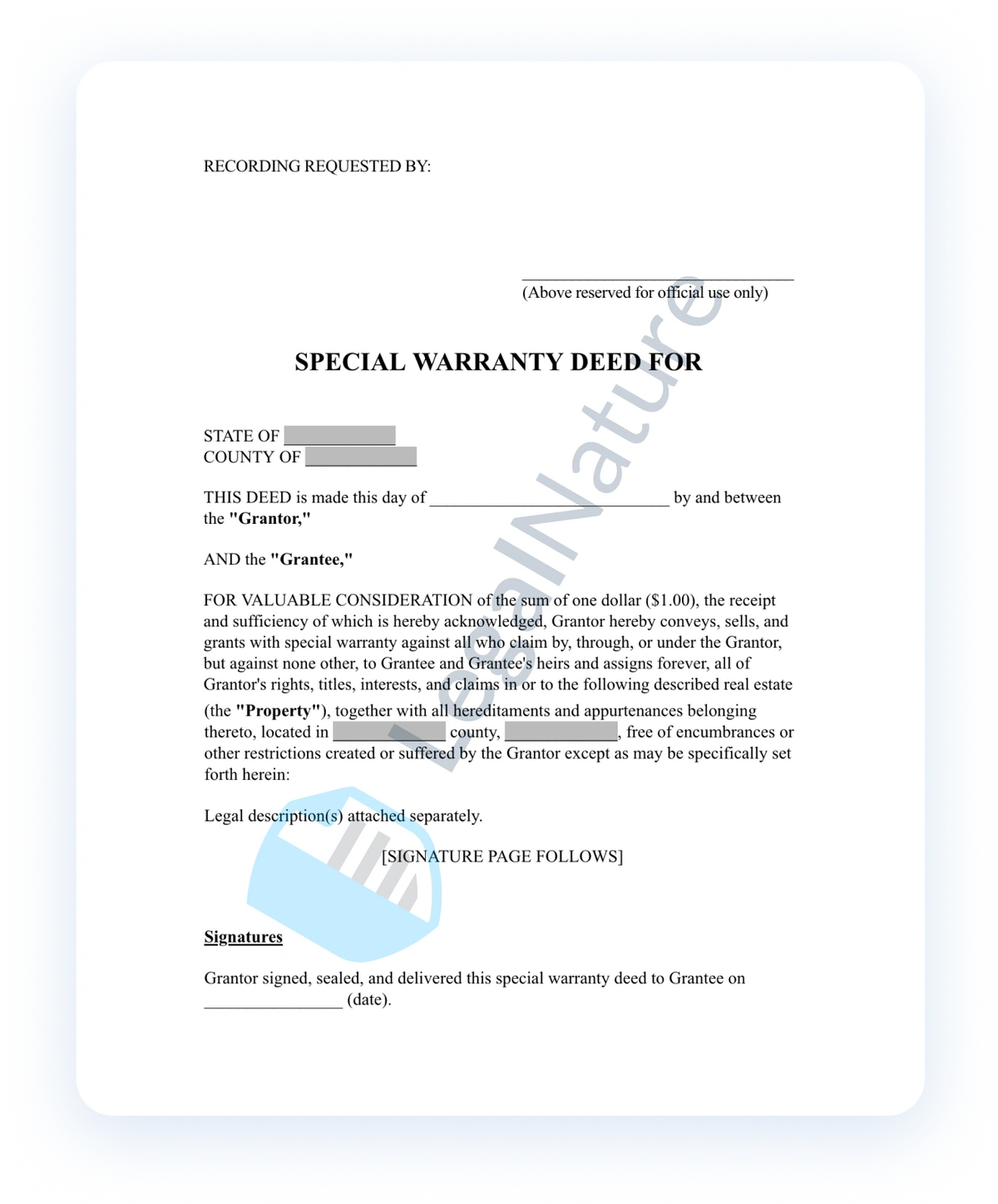
Special Warranty Deed A special warranty deed offers guarantees to the property's title only for the period during which the seller owned the property.
Create a quit claim deed in your state
What sets quit claim deeds apart from other property deeds?
-
The grantor does not assure that they have valid ownership or rights to the property. They simply transfer whatever interest they might have, if any, thereby transferring ownership of their interest to the grantee.
-
Unlike warranty deeds, quit claim deeds do not provide any protection against potential title defects or claims. The grantee accepts the risk that the grantor may not have a valid ownership interest.
-
The deed transfers any interest that the grantor has in the property to the grantee, but it does not ensure that this interest is valid or that the property is free from other claims. In other words, a quitclaim deed transfers ownership without any guarantees.
-
Quit claim deeds are often used in non-sale situations, such as transferring property between family members, adding or removing a spouse from a title, or clarifying ownership in estate planning scenarios. Quitclaim deeds are commonly used for property transfer between trusted parties, especially when transferring ownership outside of a traditional sale.
In essence, a quit claim deed offers a straightforward way to transfer property rights quickly, but without providing any legal assurances about the property’s title or the grantor’s ownership rights.
Steps to create your quit claim deed
Identify the grantor and grantee.
Confirm the legal names and current addresses of the person transferring the property (grantor) and the person receiving it (grantee).
Locate the legal description of the property.
Use the legal description from the current deed or county records rather than just the street address to avoid recording delays.
Complete the deed using LegalNature's online questionnaire.
Fill out our intuitive and state-specific form to create a legally sufficient quit claim deed to meet your needs.
Sign and notarize the deed.
In most states, your quit claim deed will be considered effective and executed once it has been both signed by the grantor and also delivered to, and accepted by, the grantee. Some counties require that the grantee sign as well, but most do not.
File your quit claim deed
Although it is not always required, filing your quit claim deed is highly recommended. By recording your completed deed as soon as possible, you gain legal protection from potential adverse claims by other parties.
Why create a quit claim deed?
-
Quit claim deeds, sometimes referred to as "quick claim" deeds due to the speed of the process, are straightforward and quick to prepare, making them ideal for urgent situations such as family adjustments or estate planning.
-
They are generally less expensive than other types of deeds because they do not require extensive title searches or title insurance.
-
Quit claim deeds are useful for transferring property among family members or between individuals and trusts, as they do not require proof of ownership or title insurance.
-
They can efficiently transfer property to heirs or beneficiaries, as a quitclaim deed transfers ownership and can help avoid the probate process.
-
Quit claim deeds can be used as part of an estate plan to transfer property outside of probate, helping to streamline or bypass the probate process.
-
Quit claim deeds can be used to clarify or correct title errors by transferring the current owner’s interest.
-
They facilitate the transfer of property interests between spouses during divorce or separation.
-
Quit claim deeds are commonly used to add or remove a spouse’s name from a property title after marriage or divorce.
Overall, quit claim deeds provide a quick and simple way to transfer property rights, as the deed permanently transfers ownership, particularly in situations involving trusted parties or non-sale transactions.

Why choose LegalNature?
Quit Claim Deed Guide
Property deeds are useful for quickly and easily transferring title to real estate to a new owner. LegalNature's property deed form allows you to draft the right deed for your needs.
Property Interest and Legal Description
When using a quitclaim deed form to transfer property, it’s essential to understand two key elements: property interest and legal description. The property interest refers to the ownership rights or claims that the grantor—the person transferring the property—holds in the real property or land. With quitclaim deeds, the grantor transfers whatever interest they have, if any, to the new property owner, but without any guarantees about the validity of that interest.
Equally important is the legal description of the property. This is a detailed, formal description that precisely identifies the property being transferred. Unlike a simple street address, the legal description includes information such as the property’s boundaries, parcel number, and any unique identifiers that distinguish it from other properties. You can typically obtain the legal description from the county clerk’s office, a previous deed, or through a title search. Including an accurate legal description in your quitclaim deed helps prevent disputes over property boundaries or ownership claims, ensuring that the transfer of property ownership is clear and legally recognized.
In addition to the legal description, the quitclaim deed should specify the grantor’s interest in the property. For example, if the property is owned jointly with other parties, or if the grantor only holds a partial interest, this should be clearly stated in the deed form. Providing this information helps establish a clear chain of title, which is crucial for the new property owner and any future property transfers.
It’s important to remember that, unlike warranty deeds, quitclaim deeds do not offer title insurance or any guarantees about the property’s title. This means the new owner assumes the risk of any title problems or claims that may arise after the property is transferred. While this makes quitclaim deeds less protective than warranty deeds, they are still a valuable tool for transferring property ownership in non sale situations, such as between family members or to resolve title issues.
In summary, when preparing a quitclaim deed, take care to include a precise legal description and a clear statement of the grantor’s property interest. This attention to detail helps ensure a smooth transfer of ownership and reduces the risk of future disputes over the property’s title. Although quitclaim deeds offer less protection than warranty deeds, they remain a practical option for transferring property in certain circumstances.
Number of Grantors and Grantees
Remember, the grantor is the party that owns the property and is selling or transferring it to the grantee, or buyer. Grantors and grantees may be either individuals or business entities.
Grantor and Grantee Types
You will need to specify whether each grantor and grantee is a married individual, a non-married individual, a trustee, or a business.
If a party is receiving the property as a trustee, then the trustee should be named as the grantee, not the trust itself. The deed will state that the trustee is receiving the property on behalf of the trust. If there are multiple co-trustees, you may list the name of any one of the trustees.
If a business is receiving the property, then you will name the business as the grantee and enter the name of the agent who will sign on behalf of the business. The agent should be someone with proper authority to sign binding contracts on the behalf of the business, such as an owner, executive, or manager.
Grantee Ownership Type – Sole Owner or Co-Owner?
You will be asked whether the grantee or grantees are receiving title as sole owners or co-owners. You should select "sole owner" only if no other person will share ownership with the grantee after the deed is signed. Select "co-owner" if more than one person or business will share ownership of the property with the grantee after the deed is signed. This would be the case, for example, if the grantor is a tenant in common and is transferring his or her interest to the grantee. The other tenants in common would not necessarily join in the deed as grantors, since only the grantor is changing his or her interest.
Grantee's Property Interest
Here you should indicate what type of joint property interest the grantees are receiving. Depending on your state, you can choose between a tenancy in common, a joint tenancy, a tenancy by the entirety or community property interest, and a partnership.
Tenancy in Common
A tenancy in common is a joint property interest in which each tenant (property owner) owns an undivided share in the whole property. Each tenant may transfer his or her interest without the need for the other tenants to join in the deed. When a tenant dies, his or her share passes according to their will or under state intestacy law when no will exists. Multiple businesses sharing ownership often choose to own as tenants in common due to the simplicity and flexibility of these ownership interests.
Joint Tenancy
A joint tenancy is the same but with a few important differences. First, each tenant owns an equal interest. So if there are four joint tenants, then each has a 1/4 ownership interest in the property. Also, a joint tenant may not sell or transfer his or her interest without the consent of the other tenants. This means that all joint tenants must sign as grantors when transferring or changing ownership and must sign together as grantees when receiving ownership. Lastly, each tenant has the right of survivorship, so when a joint tenant dies, his or her interest automatically passes to the other joint tenants in equal shares.
Tenancy by the Entirety
Tenancy by the entirety and community property interests are basically identical in nature and only differ in name. They are both similar to a joint tenancy but are for married couples. The same rules apply, including right of survivorship.
Final Steps
Remember to record your deed with your local land title office, usually known as the County Recorder’s Office or County Clerk’s Office. Each county has its own unique filing requirements. Therefore, we recommend contacting your office by phone or email in order to verify that you have met their requirements.
- Be sure not to write in the margins of the pages of your deed, as your office may need to write in these. Most counties want at least a three-inch margin at the top of the first page for official use, often to stamp the date recorded.
- Do not staple the pages of your deed together.
- All signatures on the document must be originals—not copied, printed, or stamped.
Frequently asked questions
What are the essential elements of a valid property deed?
A valid property deed must be in writing, identify the parties involved, describe the property being transferred, include operative words of conveyance, be signed by the grantor, and be delivered and accepted by the grantee.
What are the main types of property deeds?
The main types of property deeds are general warranty deeds, special warranty deeds, and quit claim deeds. General warranty deeds provide the most protection for buyers, while quit claim deeds offer the least.
Does a deed need to be notarized and filed?
Yes, a deed will usually need to be notarized and filed in the public records, also called recording the deed. The deed may also need to be witnessed in accordance with your specific state law.
How does a property deed affect property taxes?
A change in ownership through a property deed can trigger a reassessment of the property's value, potentially affecting property taxes.
What is a property legal description?
A property's legal description is a detailed and precise way of identifying and locating a parcel of real estate. It serves as a unique identifier for the property, distinguishing it from all others, and often identifying the property boundaries. Legal descriptions can be found in documents such as deeds, title commitments, surveys, and property tax statements. They are also often readily available online at your county's property appraiser web page.
Create your quit claim deed in minutes
Complete our form
;fill-opacity:1;'/%3e%3cpath%20fill-rule='evenodd'%20clip-rule='evenodd'%20d='M7.17816%205.46484C8.48591%205.46484%209.81742%206.23165%2011.1727%207.76529C10.8517%208.08628%2010.6467%208.28838%2010.5575%208.3716C10.4683%208.45482%2010.2514%208.6391%209.90659%208.92442C9.56182%209.20975%209.28244%209.40591%209.06844%209.51291C8.85445%209.6199%208.5721%209.73285%208.22138%209.85173C7.87067%209.97062%207.52293%2010.0301%207.17816%2010.0301C6.75017%2010.0301%206.35785%209.97656%206.00119%209.86957C5.64453%209.76257%205.28788%209.5783%204.93122%209.31675C4.57456%209.0552%204.29518%208.83229%204.09307%208.64801C3.89096%208.46374%203.58781%208.16355%203.18359%207.74745C3.95636%206.97469%204.64291%206.40107%205.24329%206.02658C5.84367%205.65209%206.48862%205.46484%207.17816%205.46484ZM7.17816%209.37024C7.61804%209.37024%207.9955%209.20975%208.31055%208.88876C8.6256%208.56776%208.78312%208.18733%208.78312%207.74745C8.78312%207.30757%208.6256%206.92714%208.31055%206.60615C7.9955%206.28516%207.61804%206.12466%207.17816%206.12466C6.73828%206.12466%206.36082%206.28516%206.04577%206.60615C5.73072%206.92714%205.5732%207.30757%205.5732%207.74745C5.5732%208.18733%205.73072%208.56776%206.04577%208.88876C6.36082%209.20975%206.73828%209.37024%207.17816%209.37024ZM7.17816%207.1768C7.17816%207.34324%207.23166%207.47996%207.33865%207.58696C7.44565%207.69395%207.58237%207.74745%207.74881%207.74745C7.8677%207.74745%207.98658%207.70584%208.10547%207.62262V7.74745C8.10547%208.009%208.01631%208.23191%207.83798%208.41619C7.65965%208.60046%207.43971%208.6926%207.17816%208.6926C6.91661%208.6926%206.69667%208.60046%206.51834%208.41619C6.34001%208.23191%206.25085%208.009%206.25085%207.74745C6.25085%207.4859%206.34001%207.26299%206.51834%207.07872C6.69667%206.89444%206.91661%206.80231%207.17816%206.80231H7.32082C7.22571%206.9212%207.17816%207.04603%207.17816%207.1768Z'%20fill='white'%20style='fill:white;fill-opacity:1;'/%3e%3c/svg%3e)
Preview and download your document
;fill-opacity:1;'/%3e%3cg%20clip-path='url(%23clip0_10486_8655)'%3e%3cpath%20d='M10.8931%205.49519C10.8004%205.45343%2010.6879%205.48908%2010.6427%205.57565L10.4595%205.92398L10.3128%205.85879L10.5058%205.49212L10.5069%205.48906C10.508%205.48703%2010.5091%205.48397%2010.5103%205.48194C10.54%205.4137%2010.5743%205.33324%2010.5864%205.24258C10.6239%204.97267%2010.5125%204.68749%2010.2874%204.47869C10.0733%204.28007%209.74562%204.16804%209.43445%204.18534C9.36934%204.18942%209.29984%204.20062%209.22812%204.21998C9.11446%204.25053%209.00302%204.30349%208.8982%204.37785C8.82316%204.4308%208.71833%204.52146%208.64661%204.64877L8.64551%204.65184L8.64441%204.65387L7.9603%205.95657C7.95698%205.96166%207.95369%205.96675%207.95037%205.97286C7.94705%205.97795%207.94485%205.98406%207.94265%205.99017L6.17057%209.36151C6.14408%209.41244%206.13085%209.46947%206.13305%209.5265V9.52752L6.17277%2010.6143C6.17718%2010.7202%206.22022%2010.819%206.29194%2010.8964L6.18712%2011.0919C6.14078%2011.1775%206.1794%2011.2814%206.27207%2011.3242C6.29856%2011.3364%206.32724%2011.3425%206.35483%2011.3425C6.42435%2011.3425%206.49056%2011.3069%206.52366%2011.2458L6.62516%2011.0553C6.64061%2011.0563%206.65495%2011.0573%206.6704%2011.0573C6.77412%2011.0573%206.87673%2011.0278%206.9628%2010.9687L7.91392%2010.325C7.93379%2010.3118%207.95254%2010.2955%207.96909%2010.2792C7.97241%2010.2761%207.97461%2010.2731%207.97793%2010.27C7.9989%2010.2476%208.01655%2010.2222%208.0309%2010.1957L10.1483%206.16942L10.2951%206.23461L9.35169%208.02823C9.30645%208.11379%209.34507%208.21768%209.43886%208.25943C9.46535%208.27165%209.49293%208.27674%209.52052%208.27674C9.59004%208.27674%209.65735%208.24109%209.68935%208.17896L10.7023%206.25293C10.7078%206.24581%2010.7133%206.23766%2010.7177%206.2295C10.7222%206.22134%2010.7244%206.21422%2010.7277%206.20606L10.9804%205.72533C11.0255%205.64082%2010.9858%205.53694%2010.8931%205.49519ZM6.73994%2010.6907C6.70574%2010.7131%206.6627%2010.7182%206.62408%2010.7049C6.61857%2010.7019%206.61305%2010.6988%206.60643%2010.6958C6.60312%2010.6948%206.60092%2010.6937%206.5976%2010.6927C6.5656%2010.6723%206.54575%2010.6398%206.54463%2010.6041L6.51814%209.89623C6.76641%2010.0745%207.05219%2010.2028%207.35673%2010.2741L6.73994%2010.6907Z'%20fill='white'%20style='fill:white;fill-opacity:1;'/%3e%3cpath%20d='M5.59896%2011.03C5.55151%2011.029%205.49634%2011.03%205.43897%2011.03C5.13885%2011.0331%204.57941%2011.0382%204.40067%2010.8538C4.36976%2010.8222%204.33005%2010.7652%204.3444%2010.647C4.38634%2010.314%204.58935%209.96362%204.76811%209.65499L4.79789%209.60305C4.85638%209.50221%204.91707%209.40036%204.97664%209.30056C5.14766%209.01537%205.32421%208.72%205.46433%208.40935C5.56806%208.18018%205.62542%207.96426%205.63536%207.7697C5.64859%207.50897%205.57799%207.28183%205.42571%207.09441C5.24365%206.86932%204.97774%206.70431%204.61361%206.58821C4.31128%206.49145%203.97806%206.44154%203.68455%206.39672C3.55215%206.37635%203.42635%206.35801%203.3105%206.33561C3.20899%206.31626%203.10969%206.37737%203.08982%206.47108C3.06885%206.56478%203.13505%206.65645%203.23658%206.67479C3.36015%206.69822%203.48926%206.71756%203.62497%206.73793C4.18219%206.82248%204.81444%206.91719%205.1256%207.30118C5.30986%207.52832%205.30766%207.85628%205.11788%208.2759C4.98547%208.56925%204.81444%208.85545%204.64783%209.13248C4.58825%209.23231%204.52646%209.33619%204.46687%209.43905L4.43709%209.48998C4.2418%209.82609%204.02111%2010.207%203.97146%2010.6053C3.9472%2010.7957%203.99795%2010.9567%204.12152%2011.084C4.38082%2011.3498%204.8939%2011.3763%205.29223%2011.3763C5.34408%2011.3763%205.39485%2011.3763%205.44229%2011.3753C5.49855%2011.3753%205.55043%2011.3743%205.59456%2011.3753C5.59566%2011.3753%205.59566%2011.3753%205.59676%2011.3753C5.69939%2011.3753%205.78324%2011.2989%205.78434%2011.2041C5.78544%2011.1105%205.70266%2011.031%205.59896%2011.03Z'%20fill='white'%20style='fill:white;fill-opacity:1;'/%3e%3c/g%3e%3cdefs%3e%3cclipPath%20id='clip0_10486_8655'%3e%3crect%20width='7.91304'%20height='7.30435'%20fill='white'%20style='fill:white;fill-opacity:1;'%20transform='translate(3.08594%204.12891)'/%3e%3c/clipPath%3e%3c/defs%3e%3c/svg%3e)
Review and sign your document
