


Bill of Sale
Our bill of sale documents the important details of a transaction and serves as evidence of legal transfer of title. You can use this document for any transaction besides the sale of real estate.
Select a state


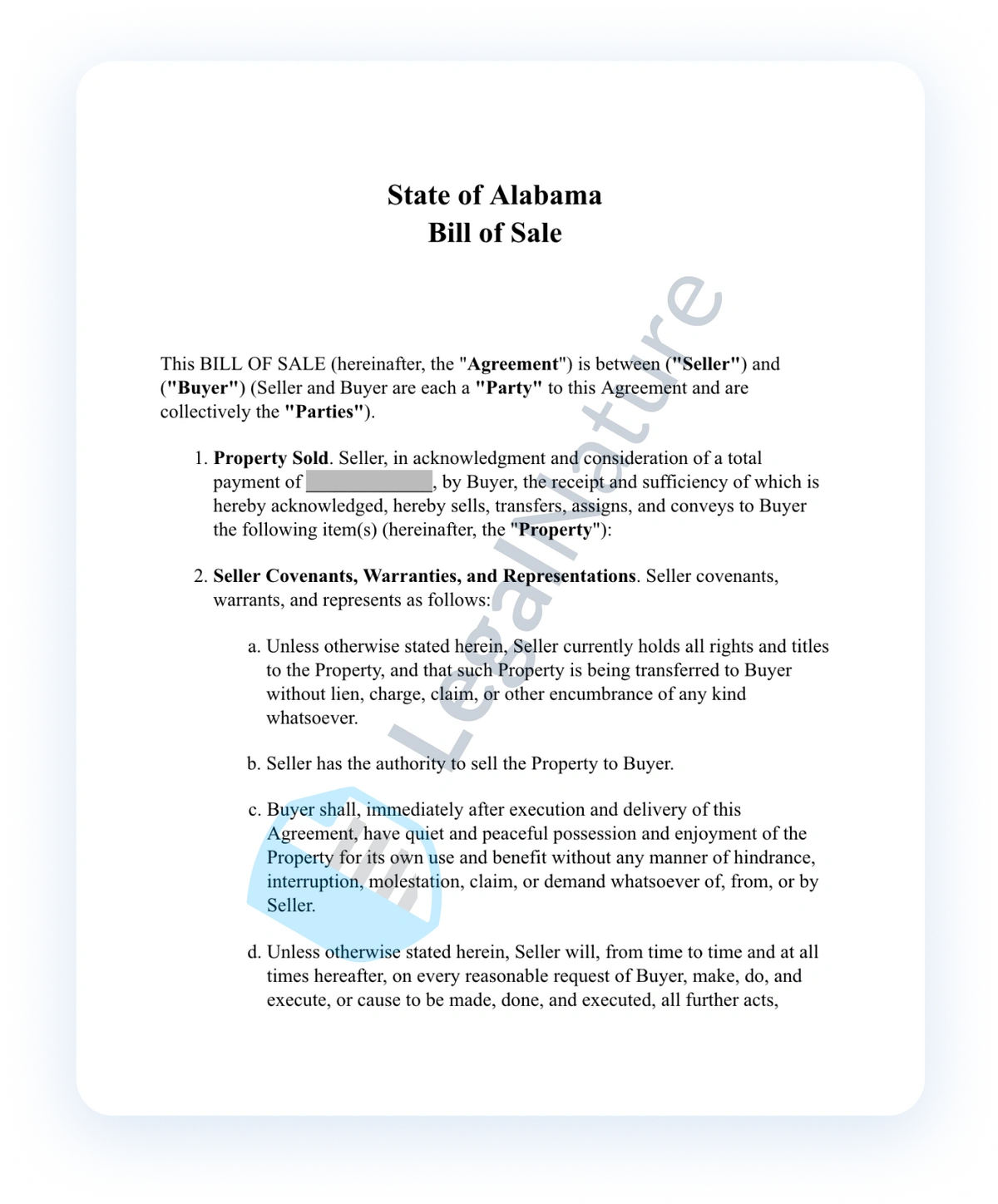
What is a bill of sale?
A bill of sale is a legal document that records the transfer of ownership of an item, asset, or property from a seller to a buyer in exchange for money or value. Generally, a bill of sale includes key details such as the parties involved, a description of the property, and the terms of the transaction, serving as formal proof of transfer. It serves as proof of purchase and provides crucial details about the transaction. Bills of sale are most commonly used when selling or purchasing valuable property such as vehicles, boats, aircraft, or even high-value personal property, but can be used for a wide range of other items as well.
Choose the right transaction document for you
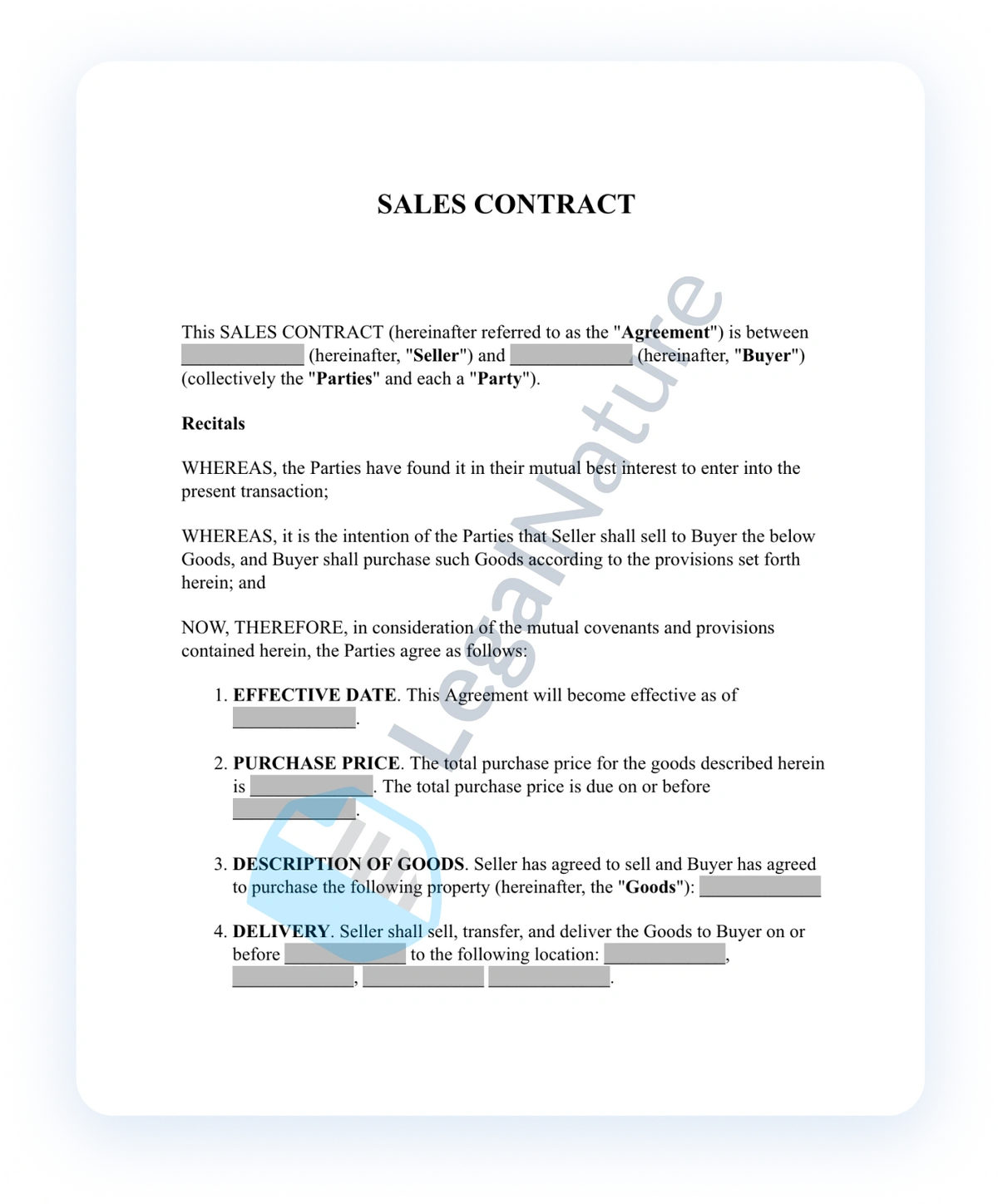
Sales Contract A sales contract is a legally binding contract between a buyer and seller that covers the buying and selling of goods. Use our customizable sales contract template to record the important terms of your transaction and provide you with thorough protection.
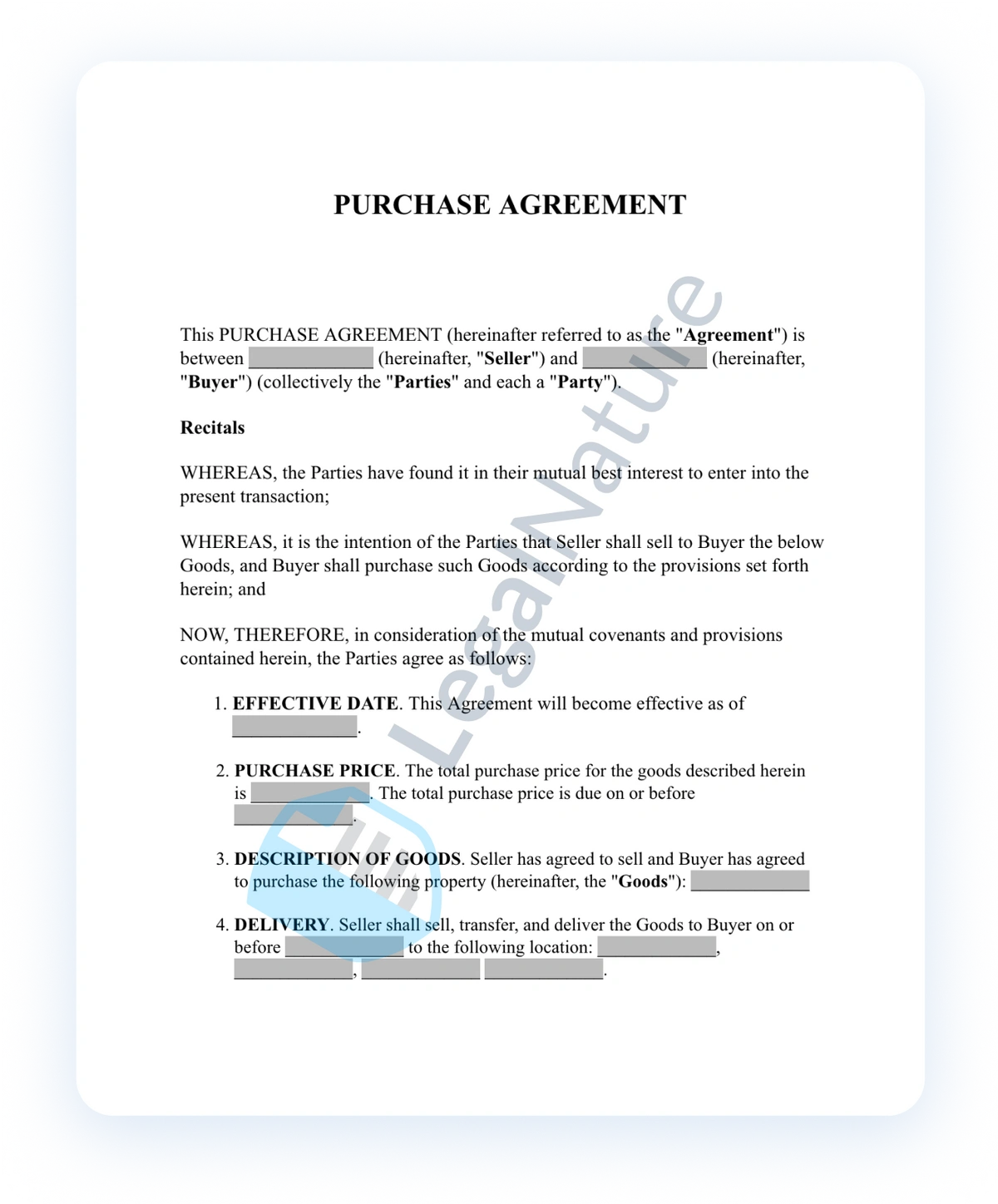
Purchase Agreement A purchase agreement is a legally binding contract between a buyer and seller that covers the buying and selling of goods. Use our customizable purchase agreement template to record the important terms of your transaction and provide you with thorough protection.
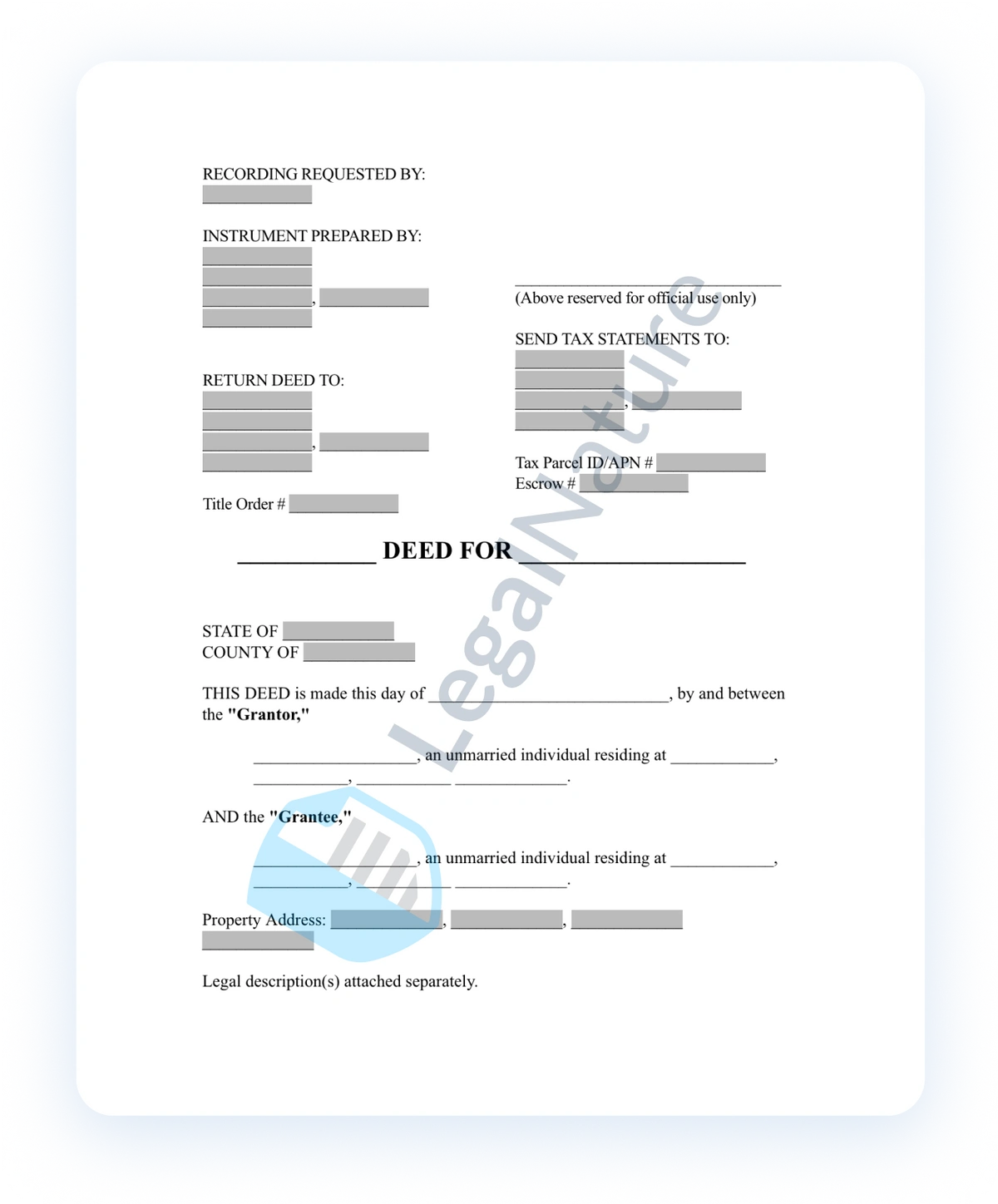
Property Deed A property deed is a legal document that is used in real estate transactions to transfer real property from one person (the grantor) to another (the grantee).
Create a bill of sale in your state
When to use a bill of sale
A bill of sale should be used whenever transferring ownership of valuable property or assets, especially when state laws, insurance companies, or registration authorities require proof of sale. The most common of these situations are:
-
Selling or buying vehicles, including cars, motorcycles, boats, and aircraft, where most states mandate a bill of sale for registration or title transfer.
-
Transferring livestock or branded animals, as certain states require bills of sale to document ownership for health and branding purposes.
-
Sale of personal property with notable value, such as equipment, furniture, artwork, and collectibles, especially when either party wants formal proof of the transaction.
-
Transactions involving real estate (often paired with other legal documents like deeds).
-
Documenting security interests in financed purchases (as with collateral for a loan).
-
Whenever state regulations or the requirements of a specific jurisdiction specifically require it, such as recording odometer readings for vehicles or notarization for watercraft sales in some states.
Depending on the jurisdiction, an official bill of sale may need to be submitted to the appropriate authorities to ensure that the transfer is legally recognized.
Create your bill of sale in 4 easy steps
Gather Information
Collect the essential elements of a bill of sale, including the names and information of the buyer and seller, a detailed description of the property being sold, the date and location of the transaction, the purchase price or value exchanged, and any warranties or guarantees expressed by either party.
Fill Out Our Intuitive Bill of Sale Form
Our intuitive form is tailored to your specific state requirements. Using the information you collect, completing our form will generate a legally compliant document for you.
Review and Sign Your Document
After thoroughly reviewing your document and ensuring the information provided is accurate, both parties must sign it.
Distribute Copies
Once your bill of sale is complete, copies should be made and distributed to both the buyer and seller, and any state agencies as required by your individual state.
Why create a bill of sale?
Creating a bill of sale is essential for formally documenting the transfer of ownership, protecting both the buyer and seller, and providing clear evidence of a legal transaction. It is generally expected that a bill of sale will accurately record the transaction details to ensure legal certainty:
-
Proof of Ownership: A bill of sale legally records the transfer from both the seller and buyer, establishing who owns the item and the exact date of ownership transfer.
-
Legal Protection: It protects both parties from future disputes, such as claims over ownership, undisclosed defects, or disagreements about the sale’s terms. If issues arise, the bill of sale serves as admissible evidence in court.
-
Registration and Compliance: For high-value property like vehicles, boats, and real estate, state agencies and other authorities may require a bill of sale to complete registration, title transfer, or tax documentation.
-
Release of Liability: It absolves the seller of future liability related to the item after it is sold by establishing a clear cut-off date and transfer agreement.
-
Clarity of Terms: Details about price, warranties, condition (as-is or otherwise), and other sale terms are clearly laid out, reducing misunderstandings between the parties.
-
Tax and Insurance Purposes: It can help both parties accurately itemize transactions for tax reporting and insurance valuation, especially for significant assets.
-
Required by Law: Some states legally require a bill of sale for specific transactions, like selling motor vehicles or animals, and may mandate it be notarized for extra assurance against fraud.
In summary, a bill of sale ensures that transactions are documented, recognized, and enforceable, helping to prevent costly legal issues and safeguarding both parties’ rights. Both the seller and buyer should store their copies of the bill of sale in a safe place for future reference, such as for registration or resolving disputes.

Why choose LegalNature?
Bill of sale help guide
Your bill of sale will serve to memorialize the important details of your transaction and acts as a receipt for the buyer. It is an essential tool for proving the terms of the agreement down the road, and many states require the use of a bill of sale when transferring automobiles, aircraft, watercraft, and similar items. Described bellow are the essential elements of a legally compliant bill of sale.
Property Type
To complete your bill of sale, start by specifying what kind of property is being sold. You will need to use multiple bills of sale if you want to transfer multiple types of property. When describing the property, include as many identifying details about the property as possible. It is also important to clearly state the item's condition in the bill of sale to ensure transparency and help prevent future disputes.
Buyer and Seller Information
Next you will need to add the names and addresses of the buyer and seller. If the buyer and/or seller is acting under a business entity, then use their respective business addresses here.
Cost and Other Terms of the Deal
You will then need to add any other important terms of the transaction, such as the price and whether there are any encumbrances on the property being sold. An “encumbrance” is a lien, loan, or other restriction on an owner’s title. Common examples include collateral for a loan, mechanic’s liens, legal judgments, tax liens, and other government liens. You should also specify the payment method, such as cash, which is often used for high-value transactions and can affect how ownership is transferred in the bill of sale. Additionally, the bill of sale may include a clause stating that the buyer accepts the item in its current 'as-is' condition, acknowledging and agreeing to the sale terms without warranties.
Witnessing Your Document
Many states require a notary public to witness both parties signing the document. However, it is recommended that you use a notary to witness the document regardless of the state you are in. This will help prove the authenticity of the document if there is ever a dispute in the future. If the buyer and seller are in different locations and want to have the document notarized, they will each need to get it notarized separately. Your bill of sale will be considered fully executed once it is completed, signed, and notarized (if included). Then make sure that both parties get a copy of the fully executed agreement.
Frequently asked questions
What is a bill of sale?
A bill of sale is a legal document that is used to certify the transfer of legal title to a new owner. As such, it acts as a receipt for both the buyer and seller and can sometimes also be used as proof of ownership by the buyer.
In many states, a bill of sale is required to document the transfer of a motor vehicle between parties. It is also commonly used in sales of equipment, animals, watercraft, and aircraft, as well as other large, expensive, or rare items.
When should I use a bill of sale?
Buyers and sellers can use a bill of sale to memorialize any sales transaction besides the purchase of real estate. These documents are frequently used when transferring title to motor vehicles, including all types of cars, trucks, recreational vehicles, motorcycles, boats, and airplanes.
While they are common for motor vehicles, bills of sale can also be used to document sales of other types of personal property such as furniture, machinery, jewelry, animals, exercise equipment, clothing, bicycles, appliances, tools, and more.
What is included in a bill of sale?
A bill of sale should, at a minimum, include information identifying the parties to the transaction (the buyer and seller), the total purchase price, and a specific description of the item that was sold.
In the case of a motor vehicle, it is important that the bill of sale includes specific identifying information such as the make, model, year, body type, and vehicle identification number (VIN number).
Bills of sale also typically include the following information:
- 'As is' language, stating that the buyer agrees to accept the item in its current condition (whether the item is currently working as originally intended or not).
- A statement that the seller has the legal authority to sell the item and that nobody else has a claim to the item.
- A provision stating that the buyer has inspected, or had an opportunity to inspect, the item before the transaction.
- Identification of the state whose laws govern the transaction.
- Sales of motor vehicles should also include the odometer reading at the time of the transfer between parties. Bills of sale for motor vehicles should include an "Odometer Disclosure Statement." In this statement, the seller affirms that the odometer reading is accurate and was not altered while in the seller's possession or at his or her direction.
Does a bill of sale include warranties?
While a bill of sale can include specific warranties, it usually does not include specific assurances or promises about the item being sold. Instead, a bill of sale typically includes an "as-is" provision. This is important because it limits the seller's future liability. The "as-is" language means that there is no warranty included and that the buyer agrees to accept the item in its current condition, whether or not faults are readily apparent.
A bill of sale may also include a statement that the seller warrants that there are no liens or other encumbrances on the property being sold and that the seller actually has proper title and the legal authority to enter into the sales transaction.
Are there limitations on when a bill of sale may be used?
A bill of sale can only be used to transfer personal property that the seller already owns and that is movable, such as motor vehicles, animals like horses or dogs, or household goods. A bill of sale cannot be used to transfer something that the seller does not own or that the seller does not have the legal right to transfer.
When selling real property (real estate), a bill of sale cannot be used. When real estate is transferred, the sale will typically be documented on a quit claim deed or a general warranty deed, although different types of deeds may be used in certain transactions.
Create your bill of sale in minutes
Complete our form
;fill-opacity:1;'/%3e%3cpath%20fill-rule='evenodd'%20clip-rule='evenodd'%20d='M7.17816%205.46484C8.48591%205.46484%209.81742%206.23165%2011.1727%207.76529C10.8517%208.08628%2010.6467%208.28838%2010.5575%208.3716C10.4683%208.45482%2010.2514%208.6391%209.90659%208.92442C9.56182%209.20975%209.28244%209.40591%209.06844%209.51291C8.85445%209.6199%208.5721%209.73285%208.22138%209.85173C7.87067%209.97062%207.52293%2010.0301%207.17816%2010.0301C6.75017%2010.0301%206.35785%209.97656%206.00119%209.86957C5.64453%209.76257%205.28788%209.5783%204.93122%209.31675C4.57456%209.0552%204.29518%208.83229%204.09307%208.64801C3.89096%208.46374%203.58781%208.16355%203.18359%207.74745C3.95636%206.97469%204.64291%206.40107%205.24329%206.02658C5.84367%205.65209%206.48862%205.46484%207.17816%205.46484ZM7.17816%209.37024C7.61804%209.37024%207.9955%209.20975%208.31055%208.88876C8.6256%208.56776%208.78312%208.18733%208.78312%207.74745C8.78312%207.30757%208.6256%206.92714%208.31055%206.60615C7.9955%206.28516%207.61804%206.12466%207.17816%206.12466C6.73828%206.12466%206.36082%206.28516%206.04577%206.60615C5.73072%206.92714%205.5732%207.30757%205.5732%207.74745C5.5732%208.18733%205.73072%208.56776%206.04577%208.88876C6.36082%209.20975%206.73828%209.37024%207.17816%209.37024ZM7.17816%207.1768C7.17816%207.34324%207.23166%207.47996%207.33865%207.58696C7.44565%207.69395%207.58237%207.74745%207.74881%207.74745C7.8677%207.74745%207.98658%207.70584%208.10547%207.62262V7.74745C8.10547%208.009%208.01631%208.23191%207.83798%208.41619C7.65965%208.60046%207.43971%208.6926%207.17816%208.6926C6.91661%208.6926%206.69667%208.60046%206.51834%208.41619C6.34001%208.23191%206.25085%208.009%206.25085%207.74745C6.25085%207.4859%206.34001%207.26299%206.51834%207.07872C6.69667%206.89444%206.91661%206.80231%207.17816%206.80231H7.32082C7.22571%206.9212%207.17816%207.04603%207.17816%207.1768Z'%20fill='white'%20style='fill:white;fill-opacity:1;'/%3e%3c/svg%3e)
Preview and download your document
;fill-opacity:1;'/%3e%3cg%20clip-path='url(%23clip0_10486_8655)'%3e%3cpath%20d='M10.8931%205.49519C10.8004%205.45343%2010.6879%205.48908%2010.6427%205.57565L10.4595%205.92398L10.3128%205.85879L10.5058%205.49212L10.5069%205.48906C10.508%205.48703%2010.5091%205.48397%2010.5103%205.48194C10.54%205.4137%2010.5743%205.33324%2010.5864%205.24258C10.6239%204.97267%2010.5125%204.68749%2010.2874%204.47869C10.0733%204.28007%209.74562%204.16804%209.43445%204.18534C9.36934%204.18942%209.29984%204.20062%209.22812%204.21998C9.11446%204.25053%209.00302%204.30349%208.8982%204.37785C8.82316%204.4308%208.71833%204.52146%208.64661%204.64877L8.64551%204.65184L8.64441%204.65387L7.9603%205.95657C7.95698%205.96166%207.95369%205.96675%207.95037%205.97286C7.94705%205.97795%207.94485%205.98406%207.94265%205.99017L6.17057%209.36151C6.14408%209.41244%206.13085%209.46947%206.13305%209.5265V9.52752L6.17277%2010.6143C6.17718%2010.7202%206.22022%2010.819%206.29194%2010.8964L6.18712%2011.0919C6.14078%2011.1775%206.1794%2011.2814%206.27207%2011.3242C6.29856%2011.3364%206.32724%2011.3425%206.35483%2011.3425C6.42435%2011.3425%206.49056%2011.3069%206.52366%2011.2458L6.62516%2011.0553C6.64061%2011.0563%206.65495%2011.0573%206.6704%2011.0573C6.77412%2011.0573%206.87673%2011.0278%206.9628%2010.9687L7.91392%2010.325C7.93379%2010.3118%207.95254%2010.2955%207.96909%2010.2792C7.97241%2010.2761%207.97461%2010.2731%207.97793%2010.27C7.9989%2010.2476%208.01655%2010.2222%208.0309%2010.1957L10.1483%206.16942L10.2951%206.23461L9.35169%208.02823C9.30645%208.11379%209.34507%208.21768%209.43886%208.25943C9.46535%208.27165%209.49293%208.27674%209.52052%208.27674C9.59004%208.27674%209.65735%208.24109%209.68935%208.17896L10.7023%206.25293C10.7078%206.24581%2010.7133%206.23766%2010.7177%206.2295C10.7222%206.22134%2010.7244%206.21422%2010.7277%206.20606L10.9804%205.72533C11.0255%205.64082%2010.9858%205.53694%2010.8931%205.49519ZM6.73994%2010.6907C6.70574%2010.7131%206.6627%2010.7182%206.62408%2010.7049C6.61857%2010.7019%206.61305%2010.6988%206.60643%2010.6958C6.60312%2010.6948%206.60092%2010.6937%206.5976%2010.6927C6.5656%2010.6723%206.54575%2010.6398%206.54463%2010.6041L6.51814%209.89623C6.76641%2010.0745%207.05219%2010.2028%207.35673%2010.2741L6.73994%2010.6907Z'%20fill='white'%20style='fill:white;fill-opacity:1;'/%3e%3cpath%20d='M5.59896%2011.03C5.55151%2011.029%205.49634%2011.03%205.43897%2011.03C5.13885%2011.0331%204.57941%2011.0382%204.40067%2010.8538C4.36976%2010.8222%204.33005%2010.7652%204.3444%2010.647C4.38634%2010.314%204.58935%209.96362%204.76811%209.65499L4.79789%209.60305C4.85638%209.50221%204.91707%209.40036%204.97664%209.30056C5.14766%209.01537%205.32421%208.72%205.46433%208.40935C5.56806%208.18018%205.62542%207.96426%205.63536%207.7697C5.64859%207.50897%205.57799%207.28183%205.42571%207.09441C5.24365%206.86932%204.97774%206.70431%204.61361%206.58821C4.31128%206.49145%203.97806%206.44154%203.68455%206.39672C3.55215%206.37635%203.42635%206.35801%203.3105%206.33561C3.20899%206.31626%203.10969%206.37737%203.08982%206.47108C3.06885%206.56478%203.13505%206.65645%203.23658%206.67479C3.36015%206.69822%203.48926%206.71756%203.62497%206.73793C4.18219%206.82248%204.81444%206.91719%205.1256%207.30118C5.30986%207.52832%205.30766%207.85628%205.11788%208.2759C4.98547%208.56925%204.81444%208.85545%204.64783%209.13248C4.58825%209.23231%204.52646%209.33619%204.46687%209.43905L4.43709%209.48998C4.2418%209.82609%204.02111%2010.207%203.97146%2010.6053C3.9472%2010.7957%203.99795%2010.9567%204.12152%2011.084C4.38082%2011.3498%204.8939%2011.3763%205.29223%2011.3763C5.34408%2011.3763%205.39485%2011.3763%205.44229%2011.3753C5.49855%2011.3753%205.55043%2011.3743%205.59456%2011.3753C5.59566%2011.3753%205.59566%2011.3753%205.59676%2011.3753C5.69939%2011.3753%205.78324%2011.2989%205.78434%2011.2041C5.78544%2011.1105%205.70266%2011.031%205.59896%2011.03Z'%20fill='white'%20style='fill:white;fill-opacity:1;'/%3e%3c/g%3e%3cdefs%3e%3cclipPath%20id='clip0_10486_8655'%3e%3crect%20width='7.91304'%20height='7.30435'%20fill='white'%20style='fill:white;fill-opacity:1;'%20transform='translate(3.08594%204.12891)'/%3e%3c/clipPath%3e%3c/defs%3e%3c/svg%3e)
Review and sign your document
