


Lease Agreement
A lease agreement should provide the parties with clarity, predictability, and solid legal protection for each part of the rental process.
Select a state


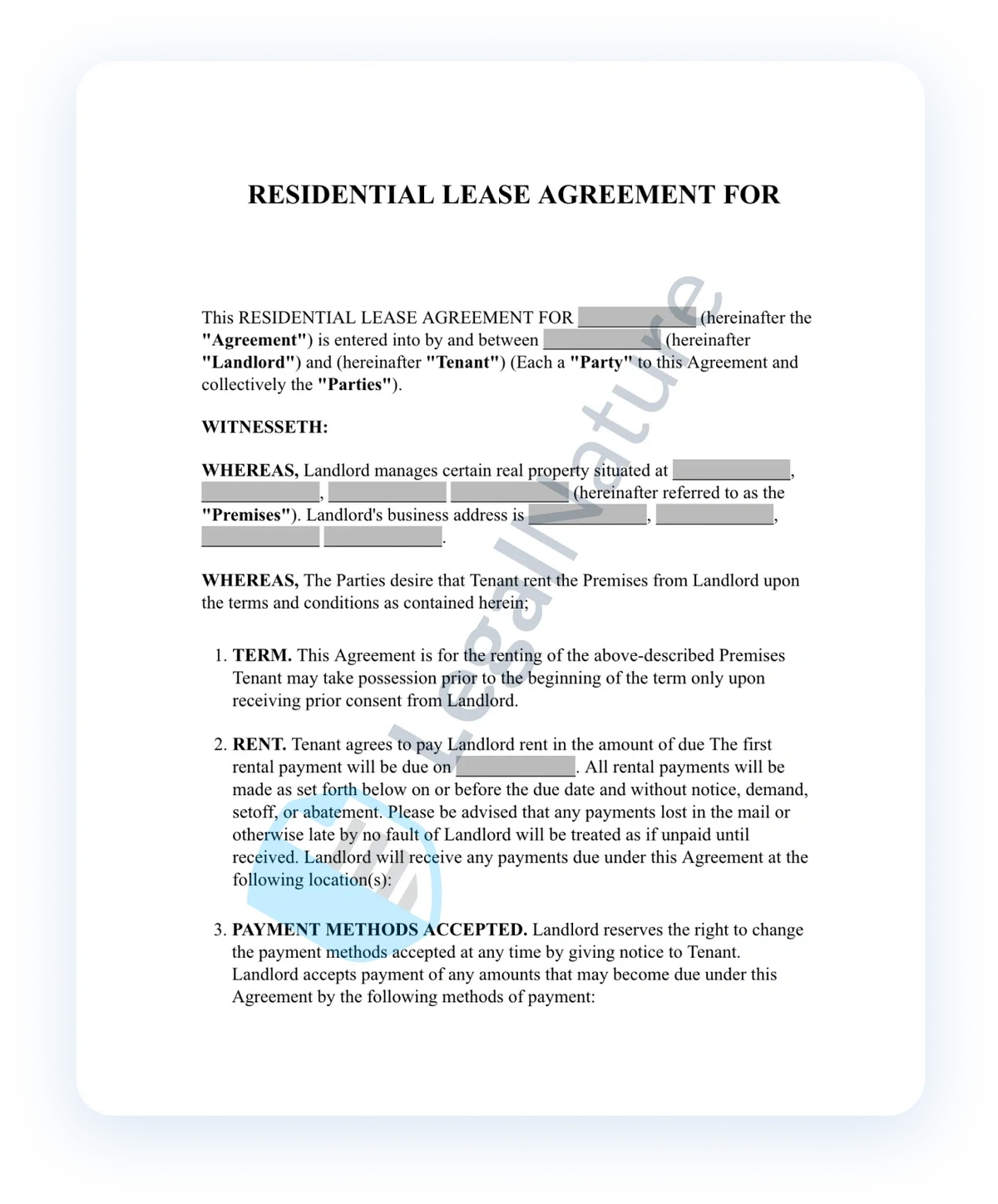
What is a lease agreement?
A lease agreement is a type of rental contract that is legally binding between a property owner (landlord) and a tenant, granting the tenant the right to occupy and use the property for a specified period in exchange for rent payments. A residential lease is a common example of such a rental contract, especially when renting property for living purposes. Lease agreements are essential when renting property, as they provide the parties with clarity, predictability, and solid legal protection for each part of the rental process.
Use the right type of lease agreement for your needs
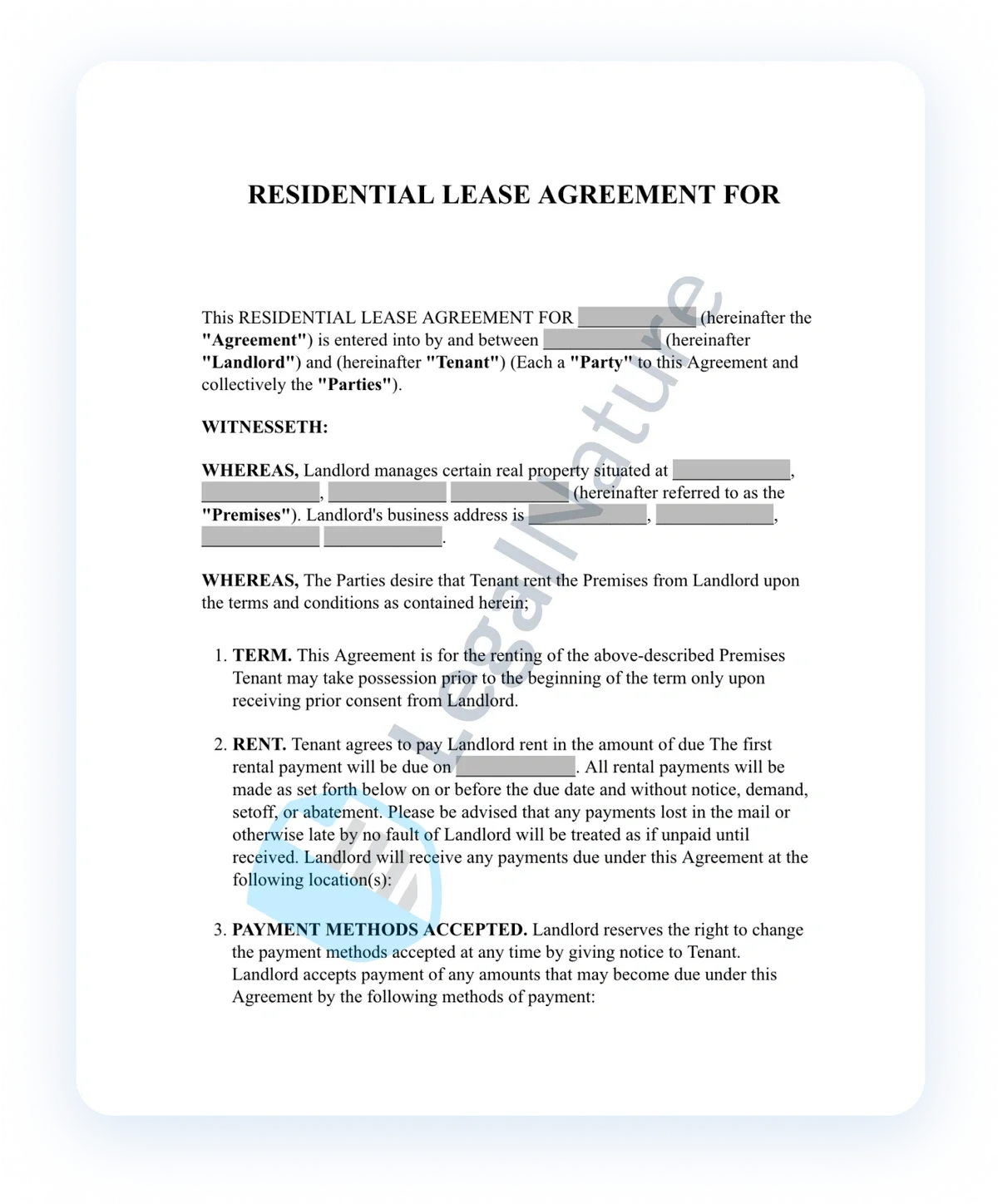
Residential Lease Agreement For renting property used as a personal dwelling (apartments, houses, condos). These leases are heavily regulated by state landlord-tenant laws that provide strong consumer protections.
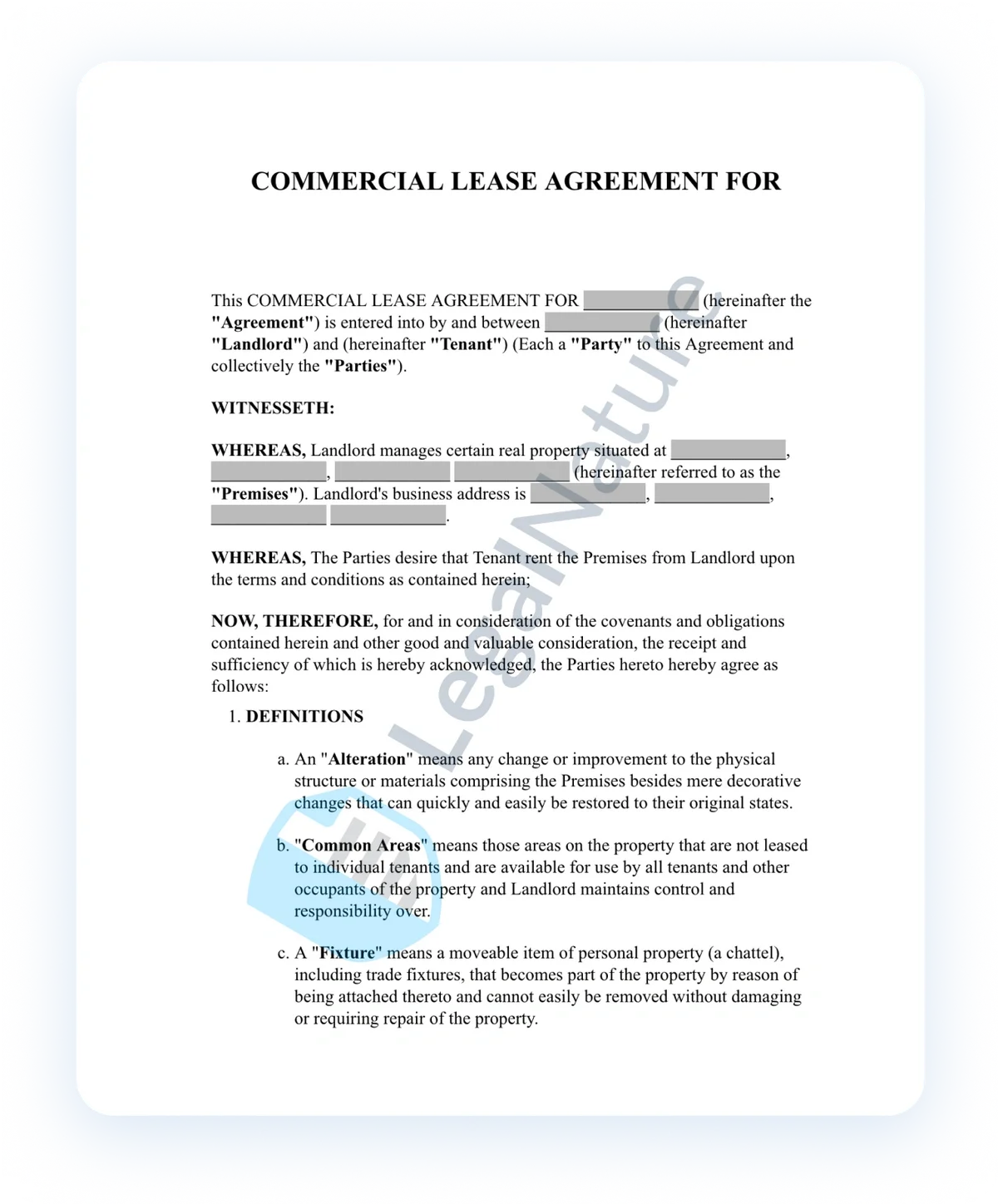
Commercial Lease Agreement For renting property used for business purposes (retail spaces, offices, warehouses, industrial facilities). These leases operate under "caveat emptor" (buyer beware) with fewer statutory protections. Terms are largely negotiable between sophisticated parties.
Create a lease agreement in your state
When to create a lease agreement
Lease agreements are created to solidify the landlord-tenant relationship between two parties. A lease agreement should be created before a tenant takes possession of the property or pays any rent. Think of it as establishing the ground rules before the game begins—you want everyone to understand and agree to the terms before any commitments are made.
The leasing process often begins with a rental application, which is used to screen and qualify tenants before drafting the standard agreement. The standard agreement serves as a foundational document that can be customized to fit the specific property and legal requirements.
Creating the lease before occupancy protects both parties from significant risks. Without a written agreement, misunderstandings about responsibilities, rules, or payment terms can quickly escalate into costly disputes.
How to create your lease agreement in 3 easy steps
Gather Information
Start with gathering basic information about the lease or sublease, including party addresses and contact information, when the agreement will begin and end, and rent and security deposit amounts. Also, now is a good time to address any special maintenance or repairs that will be needed for the unit. Consider using a rental application to collect this information from your potential tenant or subtenant.
Answer Key Questions
Use the information you collected to complete your lease agreement. We make this easy by guiding you each step of the way and helping you to customize your document to match your specific needs. As you answer certain questions, the document will adjust to accommodate your needs.
Review and Sign
Always read your document thoroughly to ensure it contains everything you need and is free of errors. In any case, once you finish creating your document, you will be able to alter it as much as you like in Microsoft Word. However, if you do not need to make any changes, you can simply download the PDF version and have the parties sign the agreement.
Why create a lease agreement?
Creating a lease agreement is not just a legal formality, but often required in many states in order to have a fully compliant and enforceable landlord-tenant relationship. Creating a lease agreement is fundamentally about transforming an informal understanding into a legally enforceable contract that protects everyone involved. A properly drafted lease agreement ensures compliance with your state's legal requirements, protecting the landlord from liability and ensuring the tenant receives all legally mandated protections and information.

Why choose LegalNature?
LegalNature offers the guidance to navigate the nuances of creating a lease agreement across all 50 states and the District of Columbia. LegalNature offers a 30-day money-back guarantee. If you're not happy, then we’re not happy. Give us a call and let us help.
Lease agreement guide
A good lease agreement should provide the parties with clarity, predictability, and solid legal protection for each part of the rental process. The following guide will walk you through the common questions and concerns when creating this agreement.
Fixed-Term vs. Periodic Tenancy
All lease agreements fall into two basic categories in terms of the rental period: fixed and periodic. A fixed-term tenancy is a tenancy for a fixed period, with a set end date, usually one or two years from the start date, as clearly defined in the lease contract. A periodic tenancy does not have a set end date and continues to automatically renew for additional periods (weekly, monthly, or yearly) until one or both parties decide to terminate the tenancy.
Some states provide tenants under fixed-term tenancies with slightly different rights than those with periodic tenancies. This difference is most apparent in terms of the tenant’s rights concerning eviction and ending the lease. Tenants must consult their leases and state law to know how to properly cancel the lease. Our agreement allows either the landlord or the tenant to terminate the tenancy by providing the appropriate advance notice according to state law.
If you select a fixed-term tenancy, then the agreement will automatically expire at the end of the term. If the parties wish to renew the agreement, then they can simply sign a new lease agreement on the same or different terms. In the event that the tenant continues to occupy the property without receiving an eviction notice, then the agreement automatically converts to a month-to-month periodic lease on the same terms unless otherwise agreed, and will continue to automatically renew until terminated by one of the parties.
Rental Payments
Rental payments are typically due on a monthly basis, and the agreement should clearly state the monthly rent amount and the due date for payment. However, you can choose to require payment weekly, twice per month, every two months, every six months, or once per year.
Tenants are required to pay rent by the due date each month. If a tenant fails to pay rent on time, late fees may be charged, and failure to pay a month's rent could result in additional penalties or legal action. You can choose to allow multiple payment methods, such as by credit card, cash, check, money order, online, or wire transfer as a convenience to the tenant. You can also specify multiple payment locations where payment is accepted, such as in person, online, or mailed to a certain address. If payment is accepted online, you will need to include the URL of the payment portal.
Signing Incentives
Landlords often offer special deals in order to encourage new tenants to sign longer-term leases or agree to increased rental payments. You should include the details regarding any such incentives agreed to by the parties. Common signing incentives include rent concessions (e.g. the first month free), waived fees, or similar non-standard benefits.
Optional Fees and Deposits
You may wish to add fees to your agreement, such as for pet-related costs, past-due rental payments, or bounced checks due to insufficient funds. Some agreements also require payment of last month's rent upfront, if any, as part of the move-in costs. With LegalNature’s agreement, you will be able to set legally sound fees that comply with state-specific requirements. Choose the fee structure that best suits your needs. Options range from simple fixed-amount fees to percentage-based fees. You can also include your own custom language for any fees or deposits you require, if any, depending on the landlord's policies.
Security Deposit
It is normally advised that landlords always collect a tenant's security deposit to protect against any damage to the property or delinquent payments. LegalNature’s agreement takes the guesswork out of setting a compliant security deposit by providing state-specific guidance. Landlords have legal obligations regarding the tenant's security deposit, including how it is held and returned. In some states, the security deposit must be kept in an interest-bearing account, and the interest may accrue to the benefit of either the landlord or the tenant, depending on state law. Keep in mind that a good lease agreement will still protect the landlord in the event that the money owed by the tenant exceeds the security deposit.
The tenant's security deposit is commonly used to repair damages that go beyond normal wear and tear, tear excepted, to any part of the unit or common areas. In practice, this means that the landlord is responsible for repairing normal deterioration that occurs over time to the unit not caused by the tenant’s negligence.
LegalNature’s agreement provides the tenant with a list of requirements that must be met in order to have their security deposit returned at the end of the lease. These requirements include the following:
- The lease term has expired or the lease has been properly terminated by the parties
- The tenant has paid all rent and outstanding fees or charges
- The tenant has paid the utility bills in full
- The tenant has returned all keys and other landlord property
- All of the tenant’s personal property has been removed
- The unit has been thoroughly cleaned
After any legitimate deductions, the landlord must return the remaining balance of the tenant's security deposit. If all conditions are met, the tenant is entitled to a full refund of the security deposit.
Substitute Tenants
You can consider including an option to allow the tenant to leave in the middle of the lease term by presenting an acceptable substitute tenant to the landlord. In such cases, the agreement of the other party—either the landlord or the tenant—may be required for the substitution to take effect. This means that the substitute tenant will take over the current tenant’s legal obligations, releasing them from the agreement. The landlord is still free to reject a substitute tenant as long as there are reasonable grounds to do so. If the substitute tenant is accepted, the landlord can then create a new lease agreement.
Subletting
Our agreement prohibits the tenant from subletting the unit to a new occupant without first obtaining the landlord’s prior written consent. Violating this requirement is cause for the landlord to evict the tenant.
Lead-Based Paint Disclosures
For all properties constructed prior to 1978 (i.e. pre-1978 property), federal law requires leases to include a "Disclosure of Information on Lead-Based Paint." LegalNature includes this disclosure for you, and all parties must sign it. Landlords must store the original signed copy for at least three years. Tenants in these properties must also receive the federally approved lead hazard information pamphlet "Protect Your Family From Lead in Your Home" or a similar pamphlet approved for use in your state by the Environmental Protection Agency.
Move-In/Move-Out Inspection Checklists
Included with your agreement is a Move-In/Move-Out Inspection Checklist to help the landlord document the condition of the premises. We highly recommend completing this checklist at both move-in and move-out regardless of your state.
Landlord Responsibilities
As a property owner, understanding your responsibilities under a lease agreement is essential for maintaining a positive landlord-tenant relationship and ensuring your rental property remains profitable and compliant with the law. Whether you are leasing a residential property or commercial property, a rental agreement—also known as a lease agreement—serves as a legally binding contract that outlines the rights and obligations of both parties.
One of the most important landlord responsibilities is to keep the rental unit in a habitable condition. This means ensuring the property meets all health and safety standards as required by federal laws and state laws, such as the South Carolina Residential Landlord and Tenant Act. Regular maintenance, prompt repairs, and providing a clean, safe environment are all part of this obligation. Failing to do so can result in legal disputes and may jeopardize your ability to collect rent or retain a tenant’s security deposit.
Landlords must also comply with all applicable regulations regarding security deposits, rent increases, and eviction procedures. For example, in a month-to-month lease, you are required to provide written notice before changing the rent amount or any other lease specifics. The notice period and procedures for these changes are typically outlined in the lease agreement and governed by state laws.
Managing the leasing process is another key responsibility. This includes screening tenants, processing rental applications, and executing a sample lease agreement that clearly states the lease term, rent amount, security deposit amount, and any additional rent or fees. Whether you are using a fixed-term lease or a month-to-month agreement, it is crucial to provide tenants with a written agreement that details all lease specifics and is signed by both parties, making it a legally binding contract.
Respecting tenant rights is fundamental. Landlords must provide tenants with a copy of the rental lease agreement and honor the terms set forth, including the procedures for handling disputes. If issues arise, such as unpaid rent or property damage, landlords are required to follow the steps outlined in the lease, including giving written notice and allowing the tenant an opportunity to cure any defaults before pursuing legal action. In the event of a legal dispute, the prevailing party may be entitled to recover attorney’s fees and costs, as specified in the lease.
Maintaining accurate records is also vital. This includes keeping copies of rental applications, lease agreements, payment records, and any written notices provided to tenants. Proper documentation helps protect both parties and ensures compliance with all legal requirements.
Final Steps
To execute your agreement, have all parties sign and date it. All parties should also receive a copy for their records.
Frequently asked questions
What is a lease agreement?
A lease creates an agreement between a property landlord and one or more tenants. It allows the tenants to occupy a property in exchange for payment. The agreement specifies the rights and obligations of all parties involved. It normally terminates after a fixed term, such as six months or one year.
A lease agreement differs from a rental agreement in that it lasts for a fixed term. A rental agreement continues as a periodic tenancy (i.e. week to week or month to month) indefinitely until one of the parties provides notice that it wishes to terminate the agreement.
When should I use a lease agreement?
It is highly recommended that a lease agreement be used whenever a landlord-tenant relationship exists. These days, a thorough and well-written lease agreement is essential for ensuring that the rights of both parties are upheld. It provides valuable recourse to parties whose rights are infringed upon. This dramatically reduces the likelihood of disputes and helps ensure all parties fulfill their end of the bargain.
What is the difference between a lease and a rental agreement?
While some people use the terms "lease agreement" and "rental agreement" interchangeably, a lease agreement is used to create a fixed-term tenancy (terminating on a set date; for example after one year), while a rental agreement creates a periodic tenancy (automatically renews until one of the parties decides to terminate it; for example a month-to-month tenancy).
What needs to be included in a lease or rental agreement?
If you search around the Internet, you will find leases and rental agreements that vary widely in terms of length, thoroughness, and format. Every state has different laws as to what must be included. However, more states agree that, at a minimum, the following items must be included:
- The name and address of all parties involved: For residential leases, the address for the tenants will normally be the address of the unit being occupied.
- The term of the agreement: Agreements may be for fixed terms, such as six months or one year, or they may be periodic, such as week to week or month to month.
- Rental payment terms: These terms include how often rent will be paid, the payment amount, where payments may be made, and the permitted payment methods (i.e. cash, check, card, direct deposit, money order, etc.).
- Deposits and fees: Deposits are normally refundable whereas fees are not. Landlords should always specify when charges are non-refundable.
- Utilities and maintenance responsibilities: The agreement must be clear as to who is responsible for paying each utility and should explain the maintenance and repair obligations.
- Prohibited uses and activities: Tenants are prohibited from engaging in illegal activities on the premises.
- Termination: The manner of terminating the agreement differs depending on the type of tenancy, preferences of the parties, and state law requirements. The agreement should also specify remedies for the landlord in case the tenant holds over occupancy beyond the term of the agreement or abandons the unit early without paying for the remainder of the term.
- Disclosures: Each state has specific disclosure requirements that must be met prior to signing the lease. You can find your local rules on your city or county website or by contacting the office of your mayor, city manager, county administrator, or a locally licensed attorney.
What is the difference between a deposit and a fee?
In the context of property leasing, deposits are normally refundable, while fees are non-refundable one-time payments. Tenants must be notified if they are being charged a "deposit" that is non-refundable.
For instance, security deposits are meant to protect landlords against tenants not paying for any damage they cause. At the end of the tenancy, deductions may be made from the deposit as permitted by state law, and the remaining funds must be returned to the tenant.
Examples of common fees include upfront fees for pets, administration costs, application processing, and cleaning fees.
Create your lease agreement in minutes
Complete our form
;fill-opacity:1;'/%3e%3cpath%20fill-rule='evenodd'%20clip-rule='evenodd'%20d='M7.17816%205.46484C8.48591%205.46484%209.81742%206.23165%2011.1727%207.76529C10.8517%208.08628%2010.6467%208.28838%2010.5575%208.3716C10.4683%208.45482%2010.2514%208.6391%209.90659%208.92442C9.56182%209.20975%209.28244%209.40591%209.06844%209.51291C8.85445%209.6199%208.5721%209.73285%208.22138%209.85173C7.87067%209.97062%207.52293%2010.0301%207.17816%2010.0301C6.75017%2010.0301%206.35785%209.97656%206.00119%209.86957C5.64453%209.76257%205.28788%209.5783%204.93122%209.31675C4.57456%209.0552%204.29518%208.83229%204.09307%208.64801C3.89096%208.46374%203.58781%208.16355%203.18359%207.74745C3.95636%206.97469%204.64291%206.40107%205.24329%206.02658C5.84367%205.65209%206.48862%205.46484%207.17816%205.46484ZM7.17816%209.37024C7.61804%209.37024%207.9955%209.20975%208.31055%208.88876C8.6256%208.56776%208.78312%208.18733%208.78312%207.74745C8.78312%207.30757%208.6256%206.92714%208.31055%206.60615C7.9955%206.28516%207.61804%206.12466%207.17816%206.12466C6.73828%206.12466%206.36082%206.28516%206.04577%206.60615C5.73072%206.92714%205.5732%207.30757%205.5732%207.74745C5.5732%208.18733%205.73072%208.56776%206.04577%208.88876C6.36082%209.20975%206.73828%209.37024%207.17816%209.37024ZM7.17816%207.1768C7.17816%207.34324%207.23166%207.47996%207.33865%207.58696C7.44565%207.69395%207.58237%207.74745%207.74881%207.74745C7.8677%207.74745%207.98658%207.70584%208.10547%207.62262V7.74745C8.10547%208.009%208.01631%208.23191%207.83798%208.41619C7.65965%208.60046%207.43971%208.6926%207.17816%208.6926C6.91661%208.6926%206.69667%208.60046%206.51834%208.41619C6.34001%208.23191%206.25085%208.009%206.25085%207.74745C6.25085%207.4859%206.34001%207.26299%206.51834%207.07872C6.69667%206.89444%206.91661%206.80231%207.17816%206.80231H7.32082C7.22571%206.9212%207.17816%207.04603%207.17816%207.1768Z'%20fill='white'%20style='fill:white;fill-opacity:1;'/%3e%3c/svg%3e)
Preview and download your document
;fill-opacity:1;'/%3e%3cg%20clip-path='url(%23clip0_10486_8655)'%3e%3cpath%20d='M10.8931%205.49519C10.8004%205.45343%2010.6879%205.48908%2010.6427%205.57565L10.4595%205.92398L10.3128%205.85879L10.5058%205.49212L10.5069%205.48906C10.508%205.48703%2010.5091%205.48397%2010.5103%205.48194C10.54%205.4137%2010.5743%205.33324%2010.5864%205.24258C10.6239%204.97267%2010.5125%204.68749%2010.2874%204.47869C10.0733%204.28007%209.74562%204.16804%209.43445%204.18534C9.36934%204.18942%209.29984%204.20062%209.22812%204.21998C9.11446%204.25053%209.00302%204.30349%208.8982%204.37785C8.82316%204.4308%208.71833%204.52146%208.64661%204.64877L8.64551%204.65184L8.64441%204.65387L7.9603%205.95657C7.95698%205.96166%207.95369%205.96675%207.95037%205.97286C7.94705%205.97795%207.94485%205.98406%207.94265%205.99017L6.17057%209.36151C6.14408%209.41244%206.13085%209.46947%206.13305%209.5265V9.52752L6.17277%2010.6143C6.17718%2010.7202%206.22022%2010.819%206.29194%2010.8964L6.18712%2011.0919C6.14078%2011.1775%206.1794%2011.2814%206.27207%2011.3242C6.29856%2011.3364%206.32724%2011.3425%206.35483%2011.3425C6.42435%2011.3425%206.49056%2011.3069%206.52366%2011.2458L6.62516%2011.0553C6.64061%2011.0563%206.65495%2011.0573%206.6704%2011.0573C6.77412%2011.0573%206.87673%2011.0278%206.9628%2010.9687L7.91392%2010.325C7.93379%2010.3118%207.95254%2010.2955%207.96909%2010.2792C7.97241%2010.2761%207.97461%2010.2731%207.97793%2010.27C7.9989%2010.2476%208.01655%2010.2222%208.0309%2010.1957L10.1483%206.16942L10.2951%206.23461L9.35169%208.02823C9.30645%208.11379%209.34507%208.21768%209.43886%208.25943C9.46535%208.27165%209.49293%208.27674%209.52052%208.27674C9.59004%208.27674%209.65735%208.24109%209.68935%208.17896L10.7023%206.25293C10.7078%206.24581%2010.7133%206.23766%2010.7177%206.2295C10.7222%206.22134%2010.7244%206.21422%2010.7277%206.20606L10.9804%205.72533C11.0255%205.64082%2010.9858%205.53694%2010.8931%205.49519ZM6.73994%2010.6907C6.70574%2010.7131%206.6627%2010.7182%206.62408%2010.7049C6.61857%2010.7019%206.61305%2010.6988%206.60643%2010.6958C6.60312%2010.6948%206.60092%2010.6937%206.5976%2010.6927C6.5656%2010.6723%206.54575%2010.6398%206.54463%2010.6041L6.51814%209.89623C6.76641%2010.0745%207.05219%2010.2028%207.35673%2010.2741L6.73994%2010.6907Z'%20fill='white'%20style='fill:white;fill-opacity:1;'/%3e%3cpath%20d='M5.59896%2011.03C5.55151%2011.029%205.49634%2011.03%205.43897%2011.03C5.13885%2011.0331%204.57941%2011.0382%204.40067%2010.8538C4.36976%2010.8222%204.33005%2010.7652%204.3444%2010.647C4.38634%2010.314%204.58935%209.96362%204.76811%209.65499L4.79789%209.60305C4.85638%209.50221%204.91707%209.40036%204.97664%209.30056C5.14766%209.01537%205.32421%208.72%205.46433%208.40935C5.56806%208.18018%205.62542%207.96426%205.63536%207.7697C5.64859%207.50897%205.57799%207.28183%205.42571%207.09441C5.24365%206.86932%204.97774%206.70431%204.61361%206.58821C4.31128%206.49145%203.97806%206.44154%203.68455%206.39672C3.55215%206.37635%203.42635%206.35801%203.3105%206.33561C3.20899%206.31626%203.10969%206.37737%203.08982%206.47108C3.06885%206.56478%203.13505%206.65645%203.23658%206.67479C3.36015%206.69822%203.48926%206.71756%203.62497%206.73793C4.18219%206.82248%204.81444%206.91719%205.1256%207.30118C5.30986%207.52832%205.30766%207.85628%205.11788%208.2759C4.98547%208.56925%204.81444%208.85545%204.64783%209.13248C4.58825%209.23231%204.52646%209.33619%204.46687%209.43905L4.43709%209.48998C4.2418%209.82609%204.02111%2010.207%203.97146%2010.6053C3.9472%2010.7957%203.99795%2010.9567%204.12152%2011.084C4.38082%2011.3498%204.8939%2011.3763%205.29223%2011.3763C5.34408%2011.3763%205.39485%2011.3763%205.44229%2011.3753C5.49855%2011.3753%205.55043%2011.3743%205.59456%2011.3753C5.59566%2011.3753%205.59566%2011.3753%205.59676%2011.3753C5.69939%2011.3753%205.78324%2011.2989%205.78434%2011.2041C5.78544%2011.1105%205.70266%2011.031%205.59896%2011.03Z'%20fill='white'%20style='fill:white;fill-opacity:1;'/%3e%3c/g%3e%3cdefs%3e%3cclipPath%20id='clip0_10486_8655'%3e%3crect%20width='7.91304'%20height='7.30435'%20fill='white'%20style='fill:white;fill-opacity:1;'%20transform='translate(3.08594%204.12891)'/%3e%3c/clipPath%3e%3c/defs%3e%3c/svg%3e)
Review and sign your document
