


Living Will
A living will allows you to clarify all medical wishes and instructions upfront in the event you become incapacitated so that no misunderstandings occur when it is too late.
Select a state


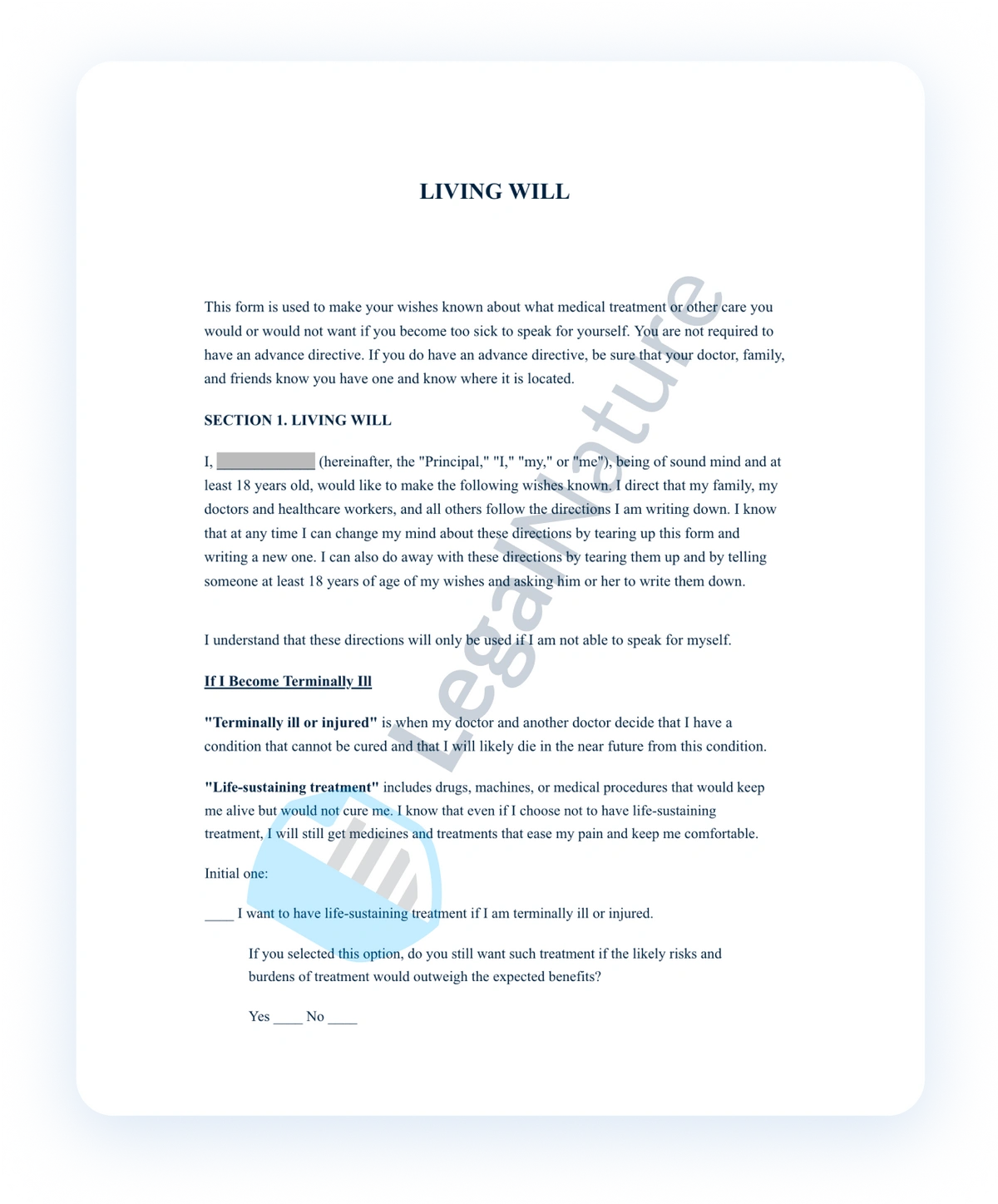
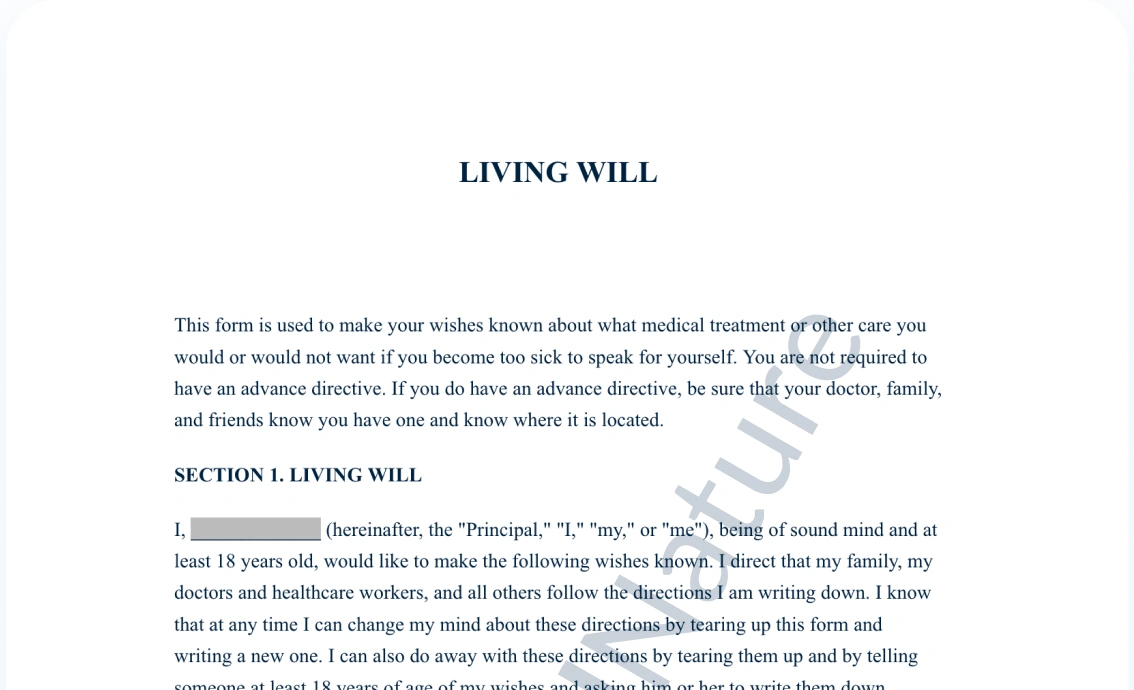
What is a living will?
A living will is a legal document that specifies an individual's preferences for medical care if they are unable to communicate their wishes due to incapacitation. It is a type of advance directive that ensures healthcare providers and loved ones understand and respect the person's treatment choices in critical situations. Unlike a medical or healthcare power of attorney, this document does not grant an agent any legal authority to act on behalf of the principal; however, our living will form includes a medical power of attorney so that you may designate a health care proxy to carry out your wishes.
Choose the appropriate estate planning document for you
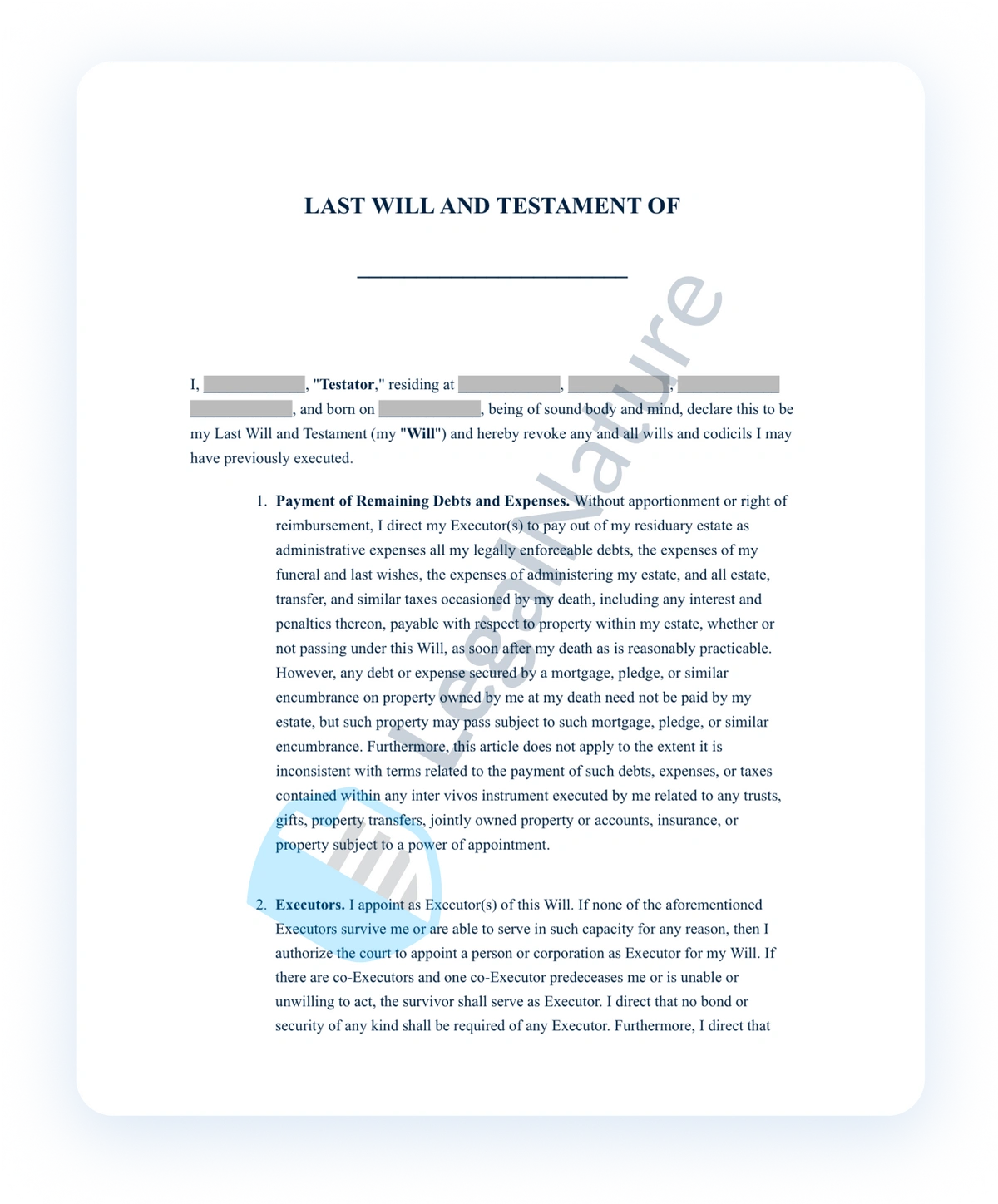
Last Will and Testament This legal document allows individuals to specify how their assets will be distributed and provide directions to loved ones upon their death.

Power of Attorney Using a power of attorney enables you to give someone permission to act on your behalf and manage medical, financial, real estate, business, or personal affairs.
Create a living will in your state
When to use a living will
A living will should be used when an individual becomes incapacitated and is no longer able to communicate their medical preferences due to specific health conditions or circumstances. It serves as a guide for healthcare providers and loved ones to ensure the person's wishes regarding medical procedures and treatments are followed. A living will only takes effect under specific conditions outlined in the document. Typically, one or more physicians must confirm that the individual's medical condition meets these specific requirements, such as terminal illness, permanent unconsciousness, or severe incapacitation.
How to create your living will
Gather Information
As you complete your living will, you will need to provide certain relevant information. This includes both the principal’s name and date of birth. You will also need some basic contact information for your healthcare agent or proxy, such as their name, phone number, and address.
Answer Key Questions
Use the information you collected to complete your living will. We make this easy by guiding you each step of the way and helping you to customize your document to match your specific needs. As you answer certain questions, the document will adjust to accommodate your needs.
Review
Always read your document thoroughly to ensure it contains everything you need and is free of errors. In any case, once you finish creating your document, you will be able to alter it as much as you like in Microsoft Word. However, if you do not need to make any changes, you can simply download the PDF version and have the parties sign the document.
Why create a living will?
Creating a living will is essential for ensuring your healthcare preferences are respected if you become unable to communicate due to illness or incapacitation. Here are the key reasons why you should consider creating one:
- Control Over Medical Decisions: A living will allows you to specify which medical treatments you want or do not want, such as life-sustaining measures like ventilators, feeding tubes, or resuscitation efforts.
- Peace of Mind: Knowing that your wishes will be honored provides comfort for both you and your loved ones. It eliminates uncertainty about your care and reduces anxiety about potential medical crises.
- Relief for Family Members: A living will removes the burden of decision-making from family members during emotionally charged situations. It prevents disagreements and ensures they are not forced to make agonizing choices without guidance.
- Prevention of Unwanted Treatments: You can refuse specific interventions that conflict with your personal or religious beliefs, or that you consider invasive or unnecessary.
- Financial Planning: A living will can help manage healthcare costs by avoiding unwanted treatments and allowing you to designate resources for medical expenses ahead of time.
Creating a living will ensures clarity in uncertain situations, reduces emotional stress on loved ones, and upholds your dignity by respecting your wishes.

Why choose LegalNature?
Living will guide
A living will allows its maker, called the "Principal," to specify his or her healthcare preferences in the event he or she is incapacitated or unable to speak. This helps the Principal and his or her family to rest easy knowing that the Principal's wishes will be honored.
Our living will gives you the option of adding a durable power of attorney for healthcare, which names a healthcare agent (also called a healthcare proxy) who can make decisions for the Principal in the event he or she lacks capacity. The Agent is required to follow the directions stated in the living will and to act in the Principal's best interest in situations in which the Principal's wishes are not specified. For this reason, it is important for the Principal to discuss his or her wishes with the Agent so that the Agent can act accordingly should the situation arise. It is a good idea for the Principal to name a trusted friend or family member as the Agent.
It is important to note that the Principal will initial next to all of his or her main preferences concerning health care once the document is printed out. Therefore, most of the questions you will answer on LegalNature's online form builder will be related to optional matters used for customizing your document according to the Principal's preferences.
Special Directions
After entering the Principal's basic information, you will have the option to specify what the Principal wants or does not want to occur when he or she becomes terminally ill, injured, or permanently unconscious. For instance, the Principal may specify any specific pain relief measures or end of life care that are wanted or not wanted. Also, describe any chronic illness or serious disability that the Principal may have that he or she does not want to be misinterpreted as a terminal condition. Again, this section is optional, so if the Principal has no specific directions then you can skip to the next step.
Guardian Nomination
On this step you have the option of nominating a guardian to manage the Principal's personal affairs in the event that he or she becomes incapacitated. This person will make decisions such as where the Principal lives or what the Principal eats. If the Principal does not nominate a guardian, a court may appoint a guardian or patient advocate when the time comes.
Designation of Primary Physician
Here you can designate the primary physician in charge of the Principal's health care. It is a good idea for the Principal to review the living will with the physician so that the physician understands the Principal's healthcare preferences and the Principal understands his or her choices.
Organ Donation and Autopsy
Including this section will allow the Principal to specify whether or not he or she wants to be an organ donor and whether an autopsy will be performed upon death. If the Principal has not specified these preferences yet in a formal document, it is probably a good idea to do so here.
Mental Health
On the following step you will have the option to include the Principal's wishes concerning mental health treatments, including whether or not the Principal consents to receiving psychotropic medications. These are medications such as antipsychotics or antidepressants. List any medications the Principal does or does not wish to receive and any other preferences concerning mental health treatments.
Funeral and Burial
The funeral and burial section allows the Principal to indicate the manner in which his or her remains will be disposed of and the location of any funeral. You can customize this section in any way you need to.
Witnessing Your Document
After completing your document, you will need to print it out and read the witnessing instructions included in it. Each state has slightly different requirements on how a living will must be witnessed and executed. If executing the living will in person, any witnesses, including any notary, will need to physically see the Principal sign the document. Many states now offer remote online notary (RON) services which eliminates the need for physical presence. Be sure to read the document carefully and have all the required persons sign. Also, your document will tell you if you need to have your signature notarized. If it says that a notary is optional, then you do not have to use a notary, but using one will help prove the document is valid if it is ever contested in court.
Registering Your Living Will
Many states maintain a registry for the living wills of their citizens. Registering the living will can help the healthcare provider and family to be able to locate a copy of it in the event they cannot find the original. If you are interested in registering, check online to see if your state maintains one and follow the directions for filing.
Changing Your Document
If the Principal decides that he or she wants to change or revoke the living will and/or durable power of attorney for health care, the Principal can do so at any time while he or she still has the mental capacity to do so.
NOTE: THIS IS AN IMPORTANT LEGAL DOCUMENT AND MAY AFFECT YOUR HEALTH CARE IN THE EVENT YOU ARE UNABLE TO SPEAK FOR YOURSELF. CONSULT A LICENSED ATTORNEY IN YOUR STATE IF THERE IS ANYTHING YOU DO NOT UNDERSTAND IN THE DOCUMENT.
Frequently asked questions
What is a living will?
A living will allows its maker, called the "Principal," to specify his or her healthcare preferences in the event he or she is incapacitated or unable to speak. Our living will gives you the option of adding a durable power of attorney for healthcare, which names a healthcare agent (also called a proxy) who can make decisions for the Principal in the event he or she lacks capacity. The Agent is required to follow the directions stated in the living will and to act in the Principal's best interest in situations in which the Principal's wishes are not specified.
Do I need to be a certain age to create a living will?
In general, if you are at least 18 years of age and of sound mind, you meet the minimum requirements to create a living will. Although some states offer a more detailed definition than others, the term "sound mind" most often means that the person understands what the document is, what it contains, and the consequences of signing it.
Why should I create a living will?
The main objective of a living will is to allow its maker, called the "Principal," to specify his or her healthcare preferences in the event he or she is incapacitated or unable to speak. This represents a substantial benefit since it helps the Principal and his or her family to rest easy knowing that the Principal's healthcare decisions and wishes will be honored.
Do I need to register my living will?
Many states maintain a registry for the living wills of their citizens. Registering the living will can help the healthcare provider and family to be able to locate a copy of it in the event they cannot find the original. If you are interested in registering, check online to see if your state maintains one and follow the directions for filing.
Can a living will be changed or revoked?
Yes. If the Principal decides that he or she wants to change or revoke the living will and/or durable power of attorney for health care, the Principal can do so at any time while he or she still has the mental capacity to do so.
Create your living will in minutes
Complete our form
;fill-opacity:1;'/%3e%3cpath%20fill-rule='evenodd'%20clip-rule='evenodd'%20d='M7.17816%205.46484C8.48591%205.46484%209.81742%206.23165%2011.1727%207.76529C10.8517%208.08628%2010.6467%208.28838%2010.5575%208.3716C10.4683%208.45482%2010.2514%208.6391%209.90659%208.92442C9.56182%209.20975%209.28244%209.40591%209.06844%209.51291C8.85445%209.6199%208.5721%209.73285%208.22138%209.85173C7.87067%209.97062%207.52293%2010.0301%207.17816%2010.0301C6.75017%2010.0301%206.35785%209.97656%206.00119%209.86957C5.64453%209.76257%205.28788%209.5783%204.93122%209.31675C4.57456%209.0552%204.29518%208.83229%204.09307%208.64801C3.89096%208.46374%203.58781%208.16355%203.18359%207.74745C3.95636%206.97469%204.64291%206.40107%205.24329%206.02658C5.84367%205.65209%206.48862%205.46484%207.17816%205.46484ZM7.17816%209.37024C7.61804%209.37024%207.9955%209.20975%208.31055%208.88876C8.6256%208.56776%208.78312%208.18733%208.78312%207.74745C8.78312%207.30757%208.6256%206.92714%208.31055%206.60615C7.9955%206.28516%207.61804%206.12466%207.17816%206.12466C6.73828%206.12466%206.36082%206.28516%206.04577%206.60615C5.73072%206.92714%205.5732%207.30757%205.5732%207.74745C5.5732%208.18733%205.73072%208.56776%206.04577%208.88876C6.36082%209.20975%206.73828%209.37024%207.17816%209.37024ZM7.17816%207.1768C7.17816%207.34324%207.23166%207.47996%207.33865%207.58696C7.44565%207.69395%207.58237%207.74745%207.74881%207.74745C7.8677%207.74745%207.98658%207.70584%208.10547%207.62262V7.74745C8.10547%208.009%208.01631%208.23191%207.83798%208.41619C7.65965%208.60046%207.43971%208.6926%207.17816%208.6926C6.91661%208.6926%206.69667%208.60046%206.51834%208.41619C6.34001%208.23191%206.25085%208.009%206.25085%207.74745C6.25085%207.4859%206.34001%207.26299%206.51834%207.07872C6.69667%206.89444%206.91661%206.80231%207.17816%206.80231H7.32082C7.22571%206.9212%207.17816%207.04603%207.17816%207.1768Z'%20fill='white'%20style='fill:white;fill-opacity:1;'/%3e%3c/svg%3e)
Preview and download your document
;fill-opacity:1;'/%3e%3cg%20clip-path='url(%23clip0_10486_8655)'%3e%3cpath%20d='M10.8931%205.49519C10.8004%205.45343%2010.6879%205.48908%2010.6427%205.57565L10.4595%205.92398L10.3128%205.85879L10.5058%205.49212L10.5069%205.48906C10.508%205.48703%2010.5091%205.48397%2010.5103%205.48194C10.54%205.4137%2010.5743%205.33324%2010.5864%205.24258C10.6239%204.97267%2010.5125%204.68749%2010.2874%204.47869C10.0733%204.28007%209.74562%204.16804%209.43445%204.18534C9.36934%204.18942%209.29984%204.20062%209.22812%204.21998C9.11446%204.25053%209.00302%204.30349%208.8982%204.37785C8.82316%204.4308%208.71833%204.52146%208.64661%204.64877L8.64551%204.65184L8.64441%204.65387L7.9603%205.95657C7.95698%205.96166%207.95369%205.96675%207.95037%205.97286C7.94705%205.97795%207.94485%205.98406%207.94265%205.99017L6.17057%209.36151C6.14408%209.41244%206.13085%209.46947%206.13305%209.5265V9.52752L6.17277%2010.6143C6.17718%2010.7202%206.22022%2010.819%206.29194%2010.8964L6.18712%2011.0919C6.14078%2011.1775%206.1794%2011.2814%206.27207%2011.3242C6.29856%2011.3364%206.32724%2011.3425%206.35483%2011.3425C6.42435%2011.3425%206.49056%2011.3069%206.52366%2011.2458L6.62516%2011.0553C6.64061%2011.0563%206.65495%2011.0573%206.6704%2011.0573C6.77412%2011.0573%206.87673%2011.0278%206.9628%2010.9687L7.91392%2010.325C7.93379%2010.3118%207.95254%2010.2955%207.96909%2010.2792C7.97241%2010.2761%207.97461%2010.2731%207.97793%2010.27C7.9989%2010.2476%208.01655%2010.2222%208.0309%2010.1957L10.1483%206.16942L10.2951%206.23461L9.35169%208.02823C9.30645%208.11379%209.34507%208.21768%209.43886%208.25943C9.46535%208.27165%209.49293%208.27674%209.52052%208.27674C9.59004%208.27674%209.65735%208.24109%209.68935%208.17896L10.7023%206.25293C10.7078%206.24581%2010.7133%206.23766%2010.7177%206.2295C10.7222%206.22134%2010.7244%206.21422%2010.7277%206.20606L10.9804%205.72533C11.0255%205.64082%2010.9858%205.53694%2010.8931%205.49519ZM6.73994%2010.6907C6.70574%2010.7131%206.6627%2010.7182%206.62408%2010.7049C6.61857%2010.7019%206.61305%2010.6988%206.60643%2010.6958C6.60312%2010.6948%206.60092%2010.6937%206.5976%2010.6927C6.5656%2010.6723%206.54575%2010.6398%206.54463%2010.6041L6.51814%209.89623C6.76641%2010.0745%207.05219%2010.2028%207.35673%2010.2741L6.73994%2010.6907Z'%20fill='white'%20style='fill:white;fill-opacity:1;'/%3e%3cpath%20d='M5.59896%2011.03C5.55151%2011.029%205.49634%2011.03%205.43897%2011.03C5.13885%2011.0331%204.57941%2011.0382%204.40067%2010.8538C4.36976%2010.8222%204.33005%2010.7652%204.3444%2010.647C4.38634%2010.314%204.58935%209.96362%204.76811%209.65499L4.79789%209.60305C4.85638%209.50221%204.91707%209.40036%204.97664%209.30056C5.14766%209.01537%205.32421%208.72%205.46433%208.40935C5.56806%208.18018%205.62542%207.96426%205.63536%207.7697C5.64859%207.50897%205.57799%207.28183%205.42571%207.09441C5.24365%206.86932%204.97774%206.70431%204.61361%206.58821C4.31128%206.49145%203.97806%206.44154%203.68455%206.39672C3.55215%206.37635%203.42635%206.35801%203.3105%206.33561C3.20899%206.31626%203.10969%206.37737%203.08982%206.47108C3.06885%206.56478%203.13505%206.65645%203.23658%206.67479C3.36015%206.69822%203.48926%206.71756%203.62497%206.73793C4.18219%206.82248%204.81444%206.91719%205.1256%207.30118C5.30986%207.52832%205.30766%207.85628%205.11788%208.2759C4.98547%208.56925%204.81444%208.85545%204.64783%209.13248C4.58825%209.23231%204.52646%209.33619%204.46687%209.43905L4.43709%209.48998C4.2418%209.82609%204.02111%2010.207%203.97146%2010.6053C3.9472%2010.7957%203.99795%2010.9567%204.12152%2011.084C4.38082%2011.3498%204.8939%2011.3763%205.29223%2011.3763C5.34408%2011.3763%205.39485%2011.3763%205.44229%2011.3753C5.49855%2011.3753%205.55043%2011.3743%205.59456%2011.3753C5.59566%2011.3753%205.59566%2011.3753%205.59676%2011.3753C5.69939%2011.3753%205.78324%2011.2989%205.78434%2011.2041C5.78544%2011.1105%205.70266%2011.031%205.59896%2011.03Z'%20fill='white'%20style='fill:white;fill-opacity:1;'/%3e%3c/g%3e%3cdefs%3e%3cclipPath%20id='clip0_10486_8655'%3e%3crect%20width='7.91304'%20height='7.30435'%20fill='white'%20style='fill:white;fill-opacity:1;'%20transform='translate(3.08594%204.12891)'/%3e%3c/clipPath%3e%3c/defs%3e%3c/svg%3e)
Review and sign your document
