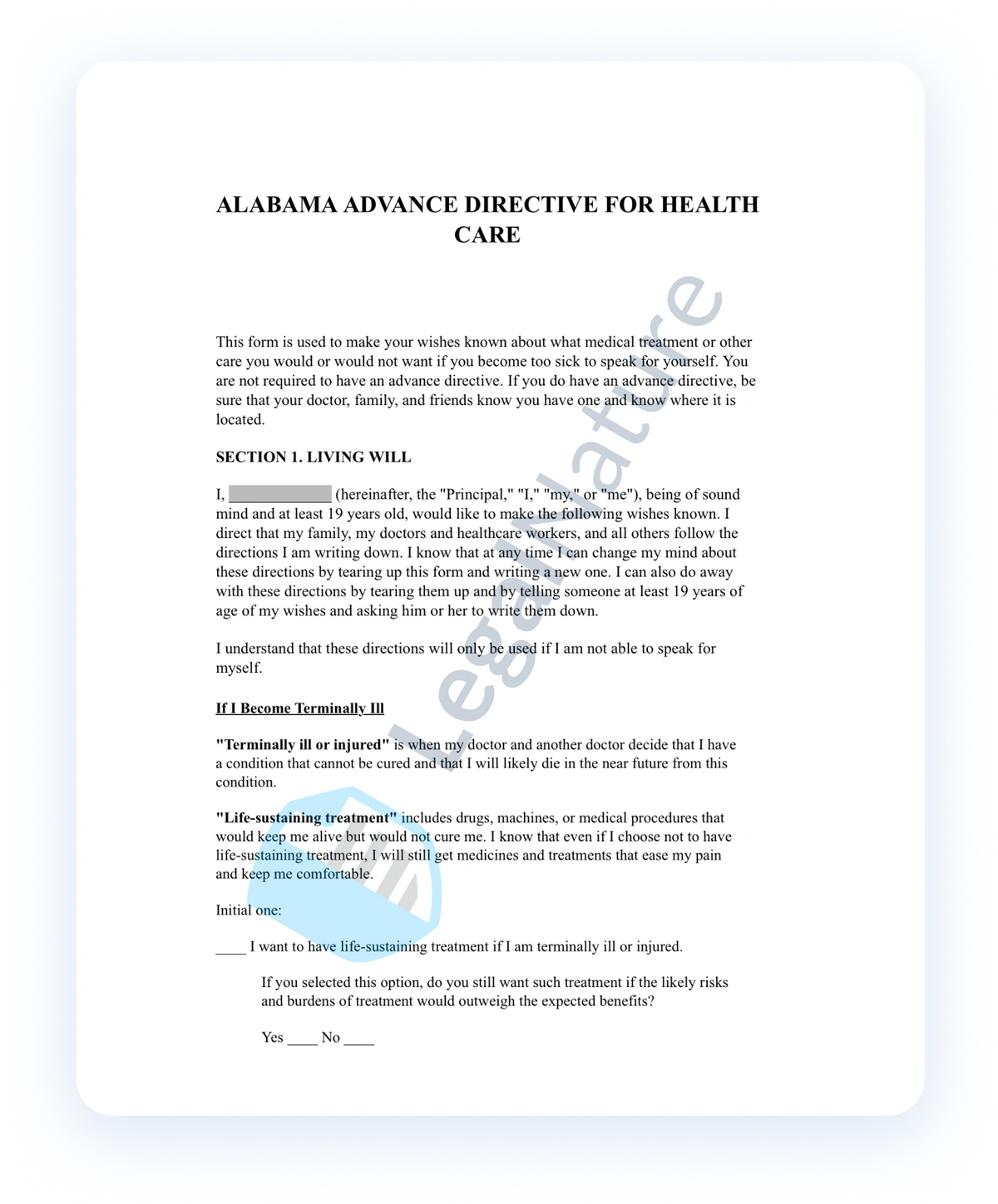

Advance Healthcare Directive
An advance healthcare directive allows you to make your wishes known about what type of medical care you want to receive should you become terminally ill or permanently unconscious. You can clarify all your medical wishes and instructions upfront so that no misunderstandings occur when it is too late.
Select a state


What is an advance healthcare directive?
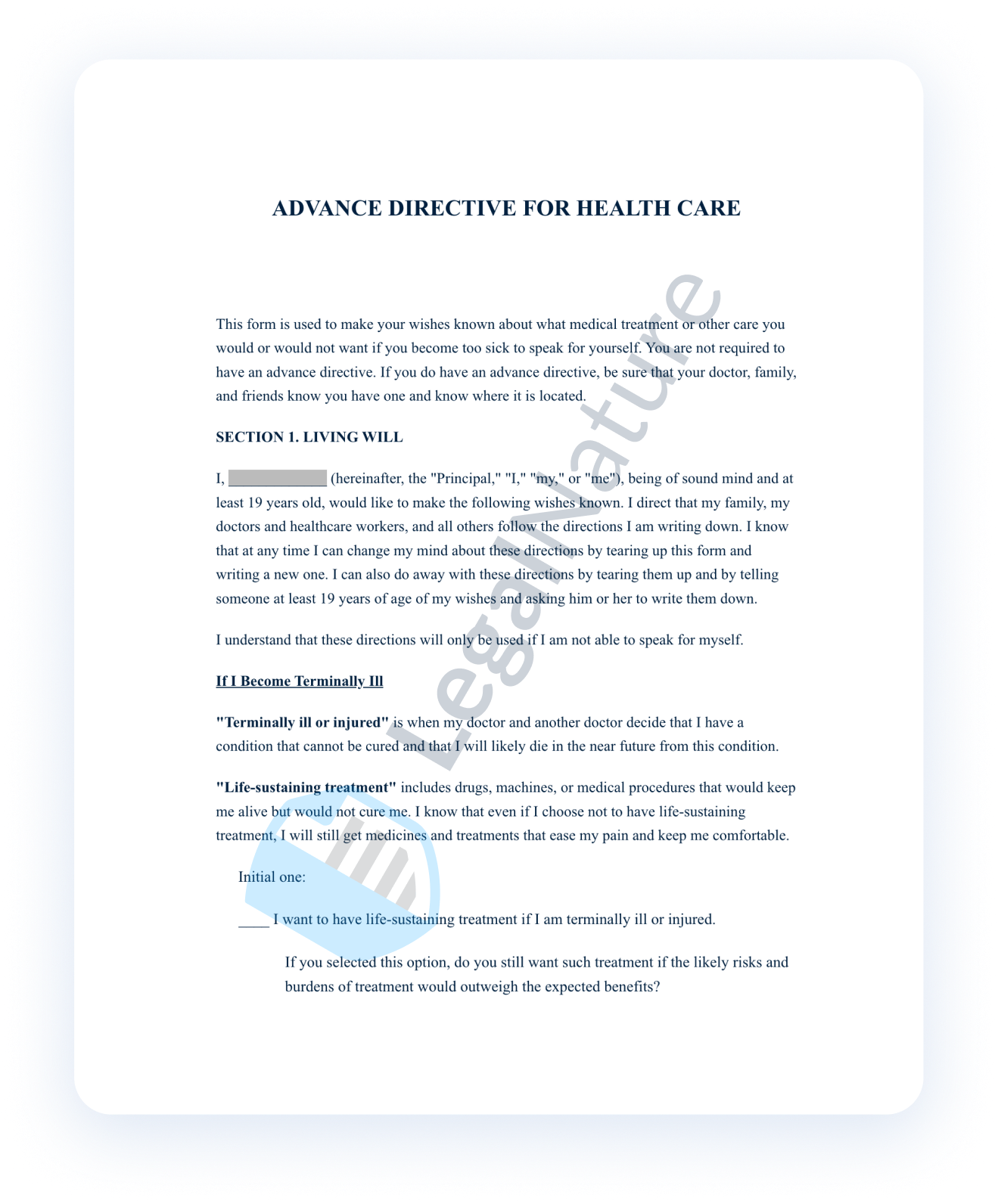
An advance healthcare directive (also known as a medical directive) is a legal document that lets a person outline their preferences for medical care if they become unable to make or communicate their own decisions due to illness or incapacity. Advance directives typically include a living will, which specifies what types of medical treatments (like life support, resuscitation, tube feeding) a person wants or does not want under certain conditions. They also often include a durable power of attorney for healthcare (sometimes called a healthcare power of attorney or healthcare proxy or surrogate), where someone is appointed to make healthcare decisions on the person’s behalf if they become incapacitated. This document provides authorization for the appointed agent to act and make decisions regarding medical care.
These documents only take effect if a physician declares that the person is unable to express their wishes regarding medical treatment, and must be in writing to be legally valid.
Choose the right advance healthcare directive for you

Living Will A living will allows you to clarify all medical wishes and instructions upfront in the event you become incapacitated so that no misunderstandings occur when it is too late.

Healthcare Power of Attorney Another name for a medical power of attorney, this power of attorney is used to designate an agent or healthcare proxy to make medical decisions on the principal's behalf if the principal becomes incapacitated or unable to communicate their wishes.
Create an advance healthcare directive in your state
When to use an advance healthcare directive
An advance healthcare directive is used when an individual becomes unable to make or communicate their own healthcare decisions, often due to illness, injury, or incapacity such as being unconscious, suffering from advanced dementia, or terminal illness. Advance healthcare directives are especially important for those facing a serious illness, as they help ensure that specific wishes are followed during critical times. The best time to create an advance healthcare directive is while competent and before any incapacitating medical situation occurs and is activated only after a physician determines the person cannot communicate or make informed medical decisions.
These legal documents ensure that the individual’s medical wishes are respected when they are unable to communicate and serve to reduce stress and potential conflict for family members during medical emergencies. They also allow individuals to document their treatment preferences in advance, making sure that choices regarding life-sustaining treatments and emergency care are clearly communicated.
Advance directives are recognized and encouraged for all adults, regardless of current health status, so that wishes are documented and honored in times of need. It is important to prepare an advance healthcare directive before a medical crisis occurs, so your preferences are known and can be followed.
How to create your advance healthcare directive
Gather Information
As you complete your advance healthcare directive, you will need to provide certain relevant information. This includes both the principal’s name and date of birth. You will also need some basic contact information for a healthcare agent or proxy, such as their name, phone number, and address, if you choose to designate one.
Answer Key Questions
Use the information you collected to complete your advance healthcare directive. We make this easy by guiding you each step of the way and helping you to customize your document to match your specific needs. As you answer certain questions, the document will adjust to accommodate your needs.
Review
Always read your document thoroughly to ensure it contains everything you need and is free of errors. In any case, once you finish creating your document, you will be able to alter it as much as you like in Microsoft Word. However, if you do not need to make any changes, you can simply download the PDF version and have the parties sign the document.
Why create an advance healthcare directive?
Creating an advance healthcare directive is important because it ensures that personal healthcare wishes are known and respected if incapacitated, while also relieving loved ones of the burden and stress of making difficult decisions during a crisis:
-
Clarity of Wishes: Clearly communicates individual preferences for treatments like life support, resuscitation, pain management, life sustaining treatment, and end-of-life care, preventing unwanted or unhelpful interventions. The directive also helps outline the course of treatment in advance, guiding healthcare professionals and caregivers during emergencies.
-
Peace of Mind: Provides peace of mind to both the individual and family members, reducing guesswork and the risk of family conflicts about medical decisions.
-
Reduces Family Burden: Prevents emotional distress for family members, who might otherwise struggle to make tough decisions without knowing the patient’s wishes. Caregivers are better able to act in accordance with the patient's wishes when an advance directive is in place.
-
Legal Protection: Ensures that the designated healthcare proxy or agent can make decisions in accordance with personal values and instructions, even if state law would otherwise default to next of kin.
-
Better Medical Outcomes: Studies show advance directives lead to higher satisfaction with care, reduce unwanted hospitalizations, increase hospice use, and improve alignment between care received and patient goals. Having the directive available in the hospital ensures that medical staff can follow the patient's wishes.
-
Avoids Unwanted Medical Costs: May help avoid unnecessary and costly high-intensity treatments near the end of life.
Advance healthcare directives are legally recognized in all 50 states and recommended for adults of all ages, so choices are honored and families are supported in difficult times.

Why choose LegalNature?
Advance Healthcare Directive Help Guide
Role of a Healthcare Proxy
A healthcare proxy, sometimes called a healthcare agent or surrogate, is a trusted individual you appoint to make healthcare decisions on your behalf if you become unable to do so. This person acts as your voice, ensuring that your healthcare wishes—outlined in your advance directives—are respected and followed by healthcare professionals and family members.
Choosing a healthcare proxy is a significant decision. It is important to select someone who understands your values, is comfortable discussing end-of-life care, and can advocate for your preferences regarding treatments such as cardiopulmonary resuscitation or other life-sustaining measures. Open communication is key: talk with your proxy about your healthcare wishes, including specific treatments you do or do not want, so they are fully prepared to act on your behalf.
Your healthcare proxy should be able to communicate clearly with both your loved ones and your medical team, especially in stressful or emotional situations. In some cases, your proxy may need to make difficult choices about your care, so it is essential they feel confident and supported in carrying out your directives. Having a knowledgeable and compassionate healthcare proxy can provide peace of mind for you and your family, ensuring your wishes are honored even when you are unable to speak for yourself.
Power of Attorney for Healthcare
A power of attorney for healthcare, also known as a durable power of attorney, is a vital legal document in advance care planning. This document authorizes a chosen agent to make healthcare decisions on your behalf if you are unable to make or communicate your own choices. By designating a power of attorney for healthcare, you ensure that your healthcare wishes, as detailed in your advance directives and living will, are respected and carried out.
When selecting your agent, choose someone you trust to act in your best interests, who is familiar with your healthcare wishes, and who can communicate effectively with healthcare professionals. Your agent should have access to all relevant documents, including your living will and any other advance directives, so they can make informed decisions that align with your preferences.
To be legally binding, your power of attorney for healthcare must be signed, witnessed, and, in many states, notarized according to state law. It is also important to review and update this document regularly, especially if your health status or wishes change, to ensure your agent’s authority and your instructions remain current and clear.
Medical Professionals and Advance Directives
Medical professionals, including doctors, nurses, and other healthcare providers, play a crucial role in honoring and implementing your advance directives. It is important to share your advance directives with your healthcare professionals so they can incorporate your healthcare wishes into your medical care plan.
Open communication with your medical team ensures that your wishes are understood and respected, especially in situations where you are unable to communicate. Healthcare professionals are responsible for following the laws and regulations regarding advance directives in your state, and for seeking guidance from your healthcare proxy or other authorized individuals if questions arise about your care.
By working closely with your healthcare professionals and keeping them informed about your advance directives, you help ensure that your medical care aligns with your values and preferences, providing clarity and support for both you and your loved ones during critical times.
Advance Directives and Loved Ones
Advance directives are not only essential for ensuring your healthcare wishes are honored; they also provide significant support and relief for your loved ones. By documenting your preferences in advance, you reduce the emotional burden and uncertainty that family members and friends may face during a medical crisis.
Discussing your advance directives with your loved ones is a key part of advance care planning. When your family members understand your healthcare wishes and know where to find your documents, they can make informed decisions with confidence, knowing they are acting in accordance with your values.
Involving your loved ones in the planning process helps build a strong support network and ensures that everyone is prepared if difficult decisions need to be made. Ultimately, advance directives are a thoughtful way to care for your family and friends, providing them with guidance and peace of mind during challenging times.
Completing Your Document
An advance healthcare directive allows its maker, called the “Principal,” to specify his or her healthcare preferences in the event he or she becomes incapacitated or unable to speak. To be legally valid, the advance healthcare directive must be in writing and properly completed according to state-specific requirements. This helps the principal and his or her family to rest easy knowing that the principal’s wishes will be honored. Each advance healthcare directive also includes a Durable Power of Attorney for Health Care section, which names a healthcare agent (also called a proxy) who can make decisions for the principal in the event he or she lacks capacity. The Durable Healthcare Power of Attorney provides written authorization for the agent to act on the principal’s behalf regarding healthcare decisions. The agent is required to follow the directions stated in the advance healthcare directive and to act in the principal’s best interest in situations in which the principal’s wishes are not specified. For this reason, it is important for the principal to discuss his or her wishes with the agent so that the agent can act accordingly should the situation arise. It is a good idea for the principal to name a trusted friend or family member as the agent.
It is important to note that the principal will initial next to all of his or her main preferences concerning health care once the document is printed out. Therefore, most of the questions you will answer on LegalNature’s online form builder will be related to optional matters used for customizing your document according to the principal’s preferences. All materials provided are intended for personal use and should be used according to the instructions.
Special Directions (Optional)
After entering the principal’s basic information, you will have the option to specify what the principal wants or does not want to occur when he or she becomes terminally ill, injured, or permanently unconscious. For instance, the principal may specify any specific pain relief measures that are wanted or not wanted. Also, describe any chronic illness, serious illness, or serious disability that the principal may have that he or she does not want to be misinterpreted as a terminal condition. This allows the principal to clarify preferences related to serious illness, ensuring their wishes are respected in healthcare planning and emergency situations. Again, this section is optional, so if the principal has no specific directions then you can skip to the next step.
Guardian Nomination (Optional)
On this step you have the option of nominating a guardian to manage the principal's personal affairs in the event he or she becomes incapacitated. This person will make decisions such as where the principal lives or what the principal eats. If the principal doesn't nominate a guardian, a court may appoint one when the time comes.
Designation of Primary Physician (Optional)
Here you can designate the primary physician in charge of the principal's health care. It is a good idea for the principal to review the advance healthcare directive with the physician so that the physician understands the principal's healthcare preferences and the principal understands his or her choices.
Organ Donation and Autopsy (Optional)
Including this section will allow the principal to specify whether or not he or she wants to be an organ donor and whether an autopsy will be performed upon death. If the principal has not specified these preferences yet in a formal document, it is probably a good idea to do so here.
Mental Health (Optional)
On this step you will have the option to include the principal's wishes concerning mental health treatments, including whether or not the principal consents to receiving psychotropic medications. These are medications such as antipsychotics or antidepressants. List any medications the principal does or does not wish to receive and any other preferences concerning mental health treatments.
Funeral and Burial (Optional)
The funeral and burial section allows the principal to indicate the manner in which his or her remains will be disposed of and the location of any funeral. You can customize this section any way you need to.
Witnessing Your Document
After completing your document, you will need to print it out and read the witnessing instructions included in it. Each state has slightly different requirements on how an advance healthcare directive must be witnessed and executed. Any witnesses, including any notary, will need to physically see the principal sign the document. Be sure to read the document carefully and have all the required persons sign. Also, your document will tell you if you need to have your signature notarized. If it says that a notary is optional, then you do not have to use a notary, but using one will help prove the document is valid if it is ever contested in court.
Registering Your Advance Healthcare Directive
Many states maintain a registry for the advance healthcare directives of their citizens. Registering the advance healthcare directive can help the healthcare provider and principal's family to be able to locate a copy of it in the event they cannot find the original. If you are interested in registering, check online to see if your state maintains one and follow the directions for filing.
Changing Your Document
If the principal decides that he or she wants to change or revoke the advance healthcare directive and/or durable power of attorney for health care, the principal can do so at any time while he or she still has the mental capacity to do so.
NOTE: THIS IS AN IMPORTANT LEGAL DOCUMENT AND MAY AFFECT YOUR HEALTH CARE IN THE EVENT YOU ARE UNABLE TO SPEAK FOR YOURSELF. CONSULT A LICENSED ATTORNEY IN YOUR STATE WITH ANY QUESTIONS OR CONCERNS.
Frequently asked questions
What is an advance healthcare directive?
An advance healthcare directive is also called a living will. This important document allows you to specify your wishes about medical treatment at the end of your life or in the event you are unable to make decisions.
Advance healthcare directives are commonly used in the following scenarios:
-
Terminal illness
-
Permanent coma
-
Persistent vegetative state
-
Traumatic brain injury
-
Dementia or Alzheimer’s disease
-
Other medical illnesses which impact mental capacity
Before the directive becomes effective for decision-making, your physicians must agree that you are unable to make decisions about your medical care. You also need to be in the medical condition that your state’s law requires, usually either with a terminal illness or in a permanent state of unconsciousness. Once these requirements are met, the healthcare providers working on your care will tailor your treatment to match your wishes stated in the document.
Advance healthcare directives are legal throughout the U.S. and you do not need a lawyer to create one. Your advance healthcare directive becomes legal as soon as you sign it (with the required witnesses).
When should I use an advance healthcare directive?
If you are concerned about what would happen to you or how you would be treated in the event of a medical crisis, injury, or illness that left you unable to make decisions, an advance healthcare directive can put your mind at ease. This practical document can ensure that your wishes are understood and followed and even makes things easier for your family if they are struggling with difficult decisions about your care. Setting up an advance directive while you are healthy and competent ensures that the document will be valid and that your loved ones understand your wishes. In a medical emergency, it is crucial to be prepared to make decisions live, as situations can change rapidly and require immediate action.
Your advance healthcare directive can include your preferences about any or all of the following aspects of care:
-
Resuscitation, including if you want CPR or electric shock stimulation
-
Ventilation by mechanical device
-
Tube feeding via IV or stomach tube
-
Dialysis to remove waste from your system if your kidneys are not working
-
Administration of antibiotics, antivirals, and other medications
-
Palliative care, comfort care, and pain management including hospice care
-
Tissue and organ donation wishes
Considering all of these factors ahead of time and incorporating the things that are important to you in your directive can give you peace of mind and ensure that your family members understand your wishes.
What is included in an advance healthcare directive?
In general, an advance healthcare directive contains the following sections and information:
-
A declaration section which states that you are in your right mind and aware of your options. This section expresses your legal right to make decisions about your care.
-
The condition you must be in before you may be considered unable to make decisions and your wishes regarding the treatment of ongoing illnesses. If you are in a coma, not mentally competent, unconscious, or in another state, you can detail when the advance directive should be enforced.
-
Your actual wishes and directions for care. This section could be long or short depending on your individual preferences. It includes directions for your doctor on what to do if you need to be resuscitated, what to do about palliative care or pain relief, and what specific actions or treatments you do not want, including ventilation, tube feeding, and resuscitation.
-
The treatments you want to have if you are incapacitated and unable to express your wishes, detailed specifically so that your treatment team and family knows what to do.
-
Your signature and the signature of your witnesses will need to be included.
The more specific you are in your advance directive and the more circumstances you outline, the easier the document will be for your healthcare providers and family to follow. You may also choose to appoint a healthcare agent (also called a proxy) in addition to creating your advance healthcare directive. This person is entrusted with making healthcare decisions for you if you are incapable of doing so for yourself and in case the circumstances in question are not covered in your advance directive.
What do I need to know to prepare my advance healthcare directive?
You do not need an attorney to create your advance healthcare directive.
If you receive a different or new diagnosis or anything changes in your health or prognosis, then you should revisit your advance healthcare directive and amend it as needed. You will need to create new forms and redistribute and replace them with all parties involved.
Can my healthcare professionals refuse to follow my advance directive?
Your advance directive should outline your wishes, but your doctors are not obligated to follow it. If your doctor has a conscientious objection to one or more of your instructions, he or she is not required to follow it. However, the doctor should transfer you to another provider who will comply.
The best way to ensure compliance with your wishes is to speak to your medical professional and healthcare team ahead of time and make sure they understand your advance directive and agree to follow it. Your family and healthcare agent can also help ensure that your wishes are followed, provided you supply them with the most up-to-date copy of your advance directive and talk to them about your specific wishes in advance.
Is a lawyer needed to complete an advance healthcare directive?
No, a lawyer is not required for this document. While you do not need an attorney, you should make sure you understand all of the provisions and the consequences involved. Your physician can help explain your options.
Although an attorney is not required, you will need to read the document carefully and sign it. One or more witnesses and a notary may be required to witness you sign the document depending on your state.
Create your advance healthcare directive in minutes
Complete our form
;fill-opacity:1;'/%3e%3cpath%20fill-rule='evenodd'%20clip-rule='evenodd'%20d='M7.17816%205.46484C8.48591%205.46484%209.81742%206.23165%2011.1727%207.76529C10.8517%208.08628%2010.6467%208.28838%2010.5575%208.3716C10.4683%208.45482%2010.2514%208.6391%209.90659%208.92442C9.56182%209.20975%209.28244%209.40591%209.06844%209.51291C8.85445%209.6199%208.5721%209.73285%208.22138%209.85173C7.87067%209.97062%207.52293%2010.0301%207.17816%2010.0301C6.75017%2010.0301%206.35785%209.97656%206.00119%209.86957C5.64453%209.76257%205.28788%209.5783%204.93122%209.31675C4.57456%209.0552%204.29518%208.83229%204.09307%208.64801C3.89096%208.46374%203.58781%208.16355%203.18359%207.74745C3.95636%206.97469%204.64291%206.40107%205.24329%206.02658C5.84367%205.65209%206.48862%205.46484%207.17816%205.46484ZM7.17816%209.37024C7.61804%209.37024%207.9955%209.20975%208.31055%208.88876C8.6256%208.56776%208.78312%208.18733%208.78312%207.74745C8.78312%207.30757%208.6256%206.92714%208.31055%206.60615C7.9955%206.28516%207.61804%206.12466%207.17816%206.12466C6.73828%206.12466%206.36082%206.28516%206.04577%206.60615C5.73072%206.92714%205.5732%207.30757%205.5732%207.74745C5.5732%208.18733%205.73072%208.56776%206.04577%208.88876C6.36082%209.20975%206.73828%209.37024%207.17816%209.37024ZM7.17816%207.1768C7.17816%207.34324%207.23166%207.47996%207.33865%207.58696C7.44565%207.69395%207.58237%207.74745%207.74881%207.74745C7.8677%207.74745%207.98658%207.70584%208.10547%207.62262V7.74745C8.10547%208.009%208.01631%208.23191%207.83798%208.41619C7.65965%208.60046%207.43971%208.6926%207.17816%208.6926C6.91661%208.6926%206.69667%208.60046%206.51834%208.41619C6.34001%208.23191%206.25085%208.009%206.25085%207.74745C6.25085%207.4859%206.34001%207.26299%206.51834%207.07872C6.69667%206.89444%206.91661%206.80231%207.17816%206.80231H7.32082C7.22571%206.9212%207.17816%207.04603%207.17816%207.1768Z'%20fill='white'%20style='fill:white;fill-opacity:1;'/%3e%3c/svg%3e)
Preview and download your document
;fill-opacity:1;'/%3e%3cg%20clip-path='url(%23clip0_10486_8655)'%3e%3cpath%20d='M10.8931%205.49519C10.8004%205.45343%2010.6879%205.48908%2010.6427%205.57565L10.4595%205.92398L10.3128%205.85879L10.5058%205.49212L10.5069%205.48906C10.508%205.48703%2010.5091%205.48397%2010.5103%205.48194C10.54%205.4137%2010.5743%205.33324%2010.5864%205.24258C10.6239%204.97267%2010.5125%204.68749%2010.2874%204.47869C10.0733%204.28007%209.74562%204.16804%209.43445%204.18534C9.36934%204.18942%209.29984%204.20062%209.22812%204.21998C9.11446%204.25053%209.00302%204.30349%208.8982%204.37785C8.82316%204.4308%208.71833%204.52146%208.64661%204.64877L8.64551%204.65184L8.64441%204.65387L7.9603%205.95657C7.95698%205.96166%207.95369%205.96675%207.95037%205.97286C7.94705%205.97795%207.94485%205.98406%207.94265%205.99017L6.17057%209.36151C6.14408%209.41244%206.13085%209.46947%206.13305%209.5265V9.52752L6.17277%2010.6143C6.17718%2010.7202%206.22022%2010.819%206.29194%2010.8964L6.18712%2011.0919C6.14078%2011.1775%206.1794%2011.2814%206.27207%2011.3242C6.29856%2011.3364%206.32724%2011.3425%206.35483%2011.3425C6.42435%2011.3425%206.49056%2011.3069%206.52366%2011.2458L6.62516%2011.0553C6.64061%2011.0563%206.65495%2011.0573%206.6704%2011.0573C6.77412%2011.0573%206.87673%2011.0278%206.9628%2010.9687L7.91392%2010.325C7.93379%2010.3118%207.95254%2010.2955%207.96909%2010.2792C7.97241%2010.2761%207.97461%2010.2731%207.97793%2010.27C7.9989%2010.2476%208.01655%2010.2222%208.0309%2010.1957L10.1483%206.16942L10.2951%206.23461L9.35169%208.02823C9.30645%208.11379%209.34507%208.21768%209.43886%208.25943C9.46535%208.27165%209.49293%208.27674%209.52052%208.27674C9.59004%208.27674%209.65735%208.24109%209.68935%208.17896L10.7023%206.25293C10.7078%206.24581%2010.7133%206.23766%2010.7177%206.2295C10.7222%206.22134%2010.7244%206.21422%2010.7277%206.20606L10.9804%205.72533C11.0255%205.64082%2010.9858%205.53694%2010.8931%205.49519ZM6.73994%2010.6907C6.70574%2010.7131%206.6627%2010.7182%206.62408%2010.7049C6.61857%2010.7019%206.61305%2010.6988%206.60643%2010.6958C6.60312%2010.6948%206.60092%2010.6937%206.5976%2010.6927C6.5656%2010.6723%206.54575%2010.6398%206.54463%2010.6041L6.51814%209.89623C6.76641%2010.0745%207.05219%2010.2028%207.35673%2010.2741L6.73994%2010.6907Z'%20fill='white'%20style='fill:white;fill-opacity:1;'/%3e%3cpath%20d='M5.59896%2011.03C5.55151%2011.029%205.49634%2011.03%205.43897%2011.03C5.13885%2011.0331%204.57941%2011.0382%204.40067%2010.8538C4.36976%2010.8222%204.33005%2010.7652%204.3444%2010.647C4.38634%2010.314%204.58935%209.96362%204.76811%209.65499L4.79789%209.60305C4.85638%209.50221%204.91707%209.40036%204.97664%209.30056C5.14766%209.01537%205.32421%208.72%205.46433%208.40935C5.56806%208.18018%205.62542%207.96426%205.63536%207.7697C5.64859%207.50897%205.57799%207.28183%205.42571%207.09441C5.24365%206.86932%204.97774%206.70431%204.61361%206.58821C4.31128%206.49145%203.97806%206.44154%203.68455%206.39672C3.55215%206.37635%203.42635%206.35801%203.3105%206.33561C3.20899%206.31626%203.10969%206.37737%203.08982%206.47108C3.06885%206.56478%203.13505%206.65645%203.23658%206.67479C3.36015%206.69822%203.48926%206.71756%203.62497%206.73793C4.18219%206.82248%204.81444%206.91719%205.1256%207.30118C5.30986%207.52832%205.30766%207.85628%205.11788%208.2759C4.98547%208.56925%204.81444%208.85545%204.64783%209.13248C4.58825%209.23231%204.52646%209.33619%204.46687%209.43905L4.43709%209.48998C4.2418%209.82609%204.02111%2010.207%203.97146%2010.6053C3.9472%2010.7957%203.99795%2010.9567%204.12152%2011.084C4.38082%2011.3498%204.8939%2011.3763%205.29223%2011.3763C5.34408%2011.3763%205.39485%2011.3763%205.44229%2011.3753C5.49855%2011.3753%205.55043%2011.3743%205.59456%2011.3753C5.59566%2011.3753%205.59566%2011.3753%205.59676%2011.3753C5.69939%2011.3753%205.78324%2011.2989%205.78434%2011.2041C5.78544%2011.1105%205.70266%2011.031%205.59896%2011.03Z'%20fill='white'%20style='fill:white;fill-opacity:1;'/%3e%3c/g%3e%3cdefs%3e%3cclipPath%20id='clip0_10486_8655'%3e%3crect%20width='7.91304'%20height='7.30435'%20fill='white'%20style='fill:white;fill-opacity:1;'%20transform='translate(3.08594%204.12891)'/%3e%3c/clipPath%3e%3c/defs%3e%3c/svg%3e)
Review and sign your document