


Corporate Resolution
A corporate resolution formally records any major decision made by a corporation, LLC, or nonprofit.
Select a state


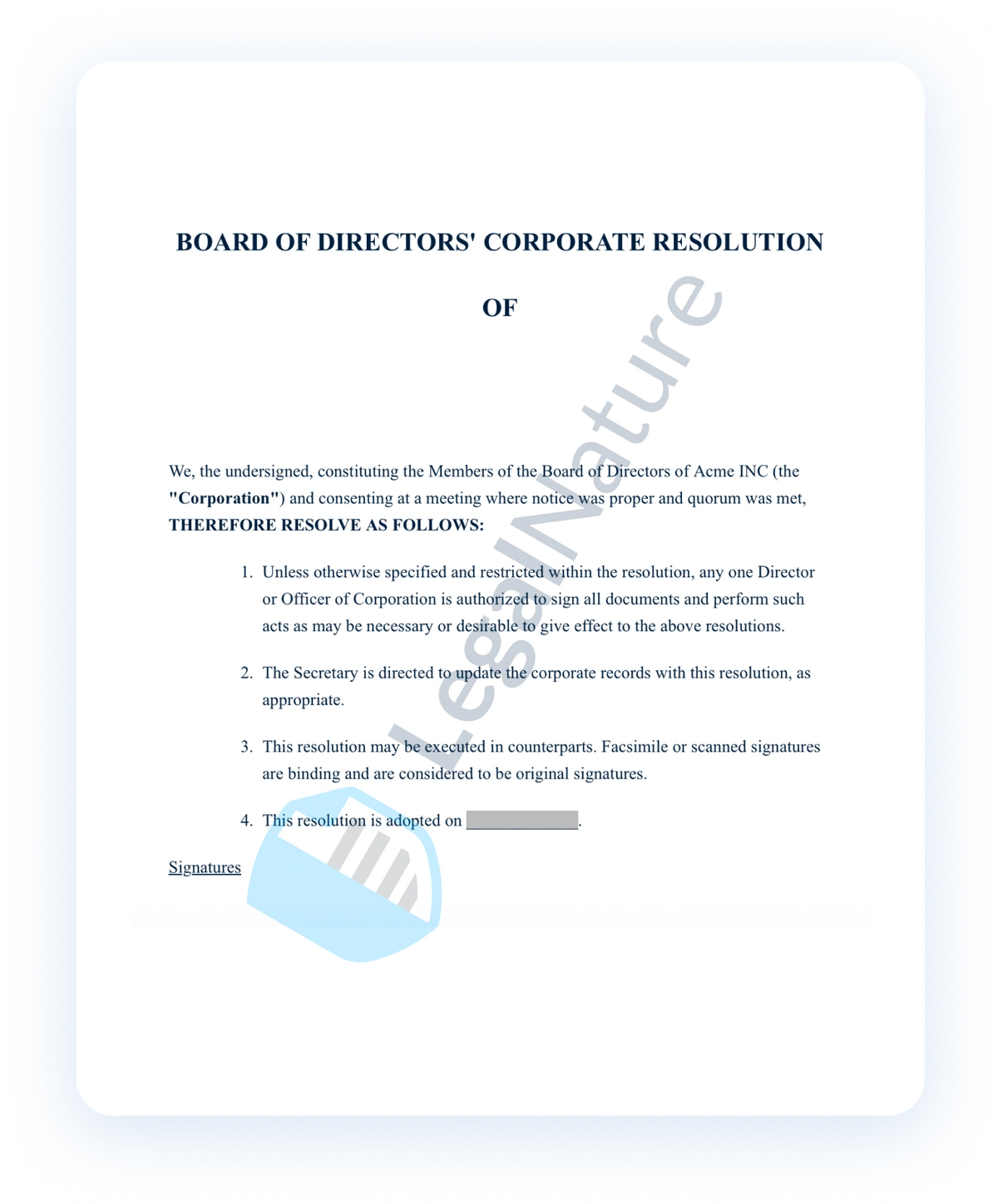
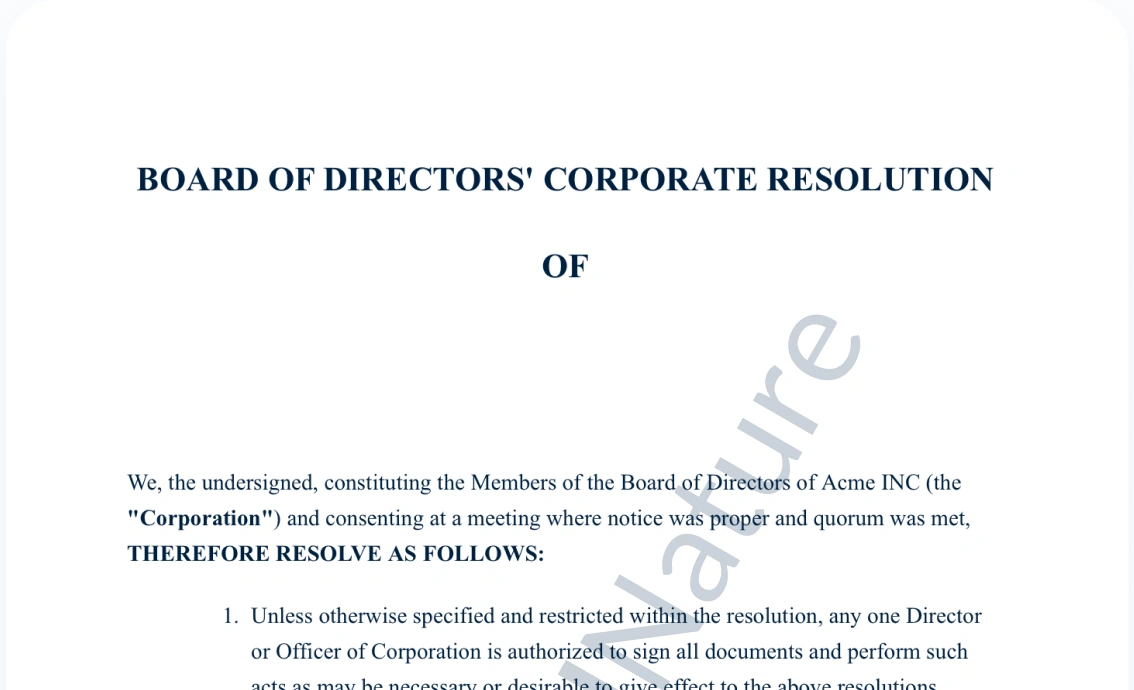
What is a corporate resolution?
A corporate resolution, sometimes referred to as a “company resolution,” is a formal written document created by a company’s board of directors, officers, managers, shareholders, or owners that records specific decisions, authorizations, or actions taken on behalf of the corporation. The definition of a corporate resolution is a written document created to formally record and authorize binding decisions made by the board.
A corporate resolution acts as a binding declaration of intent or decision made by a corporation’s directors. These binding decisions are adopted and recorded by board members and corporate officers, who are responsible for making and executing resolutions. Companies and corporations use resolutions to formalize major decisions and ensure proper governance. Executives and the company's management play a key role in implementing these resolutions.
Use the corporate document that best suits your needs
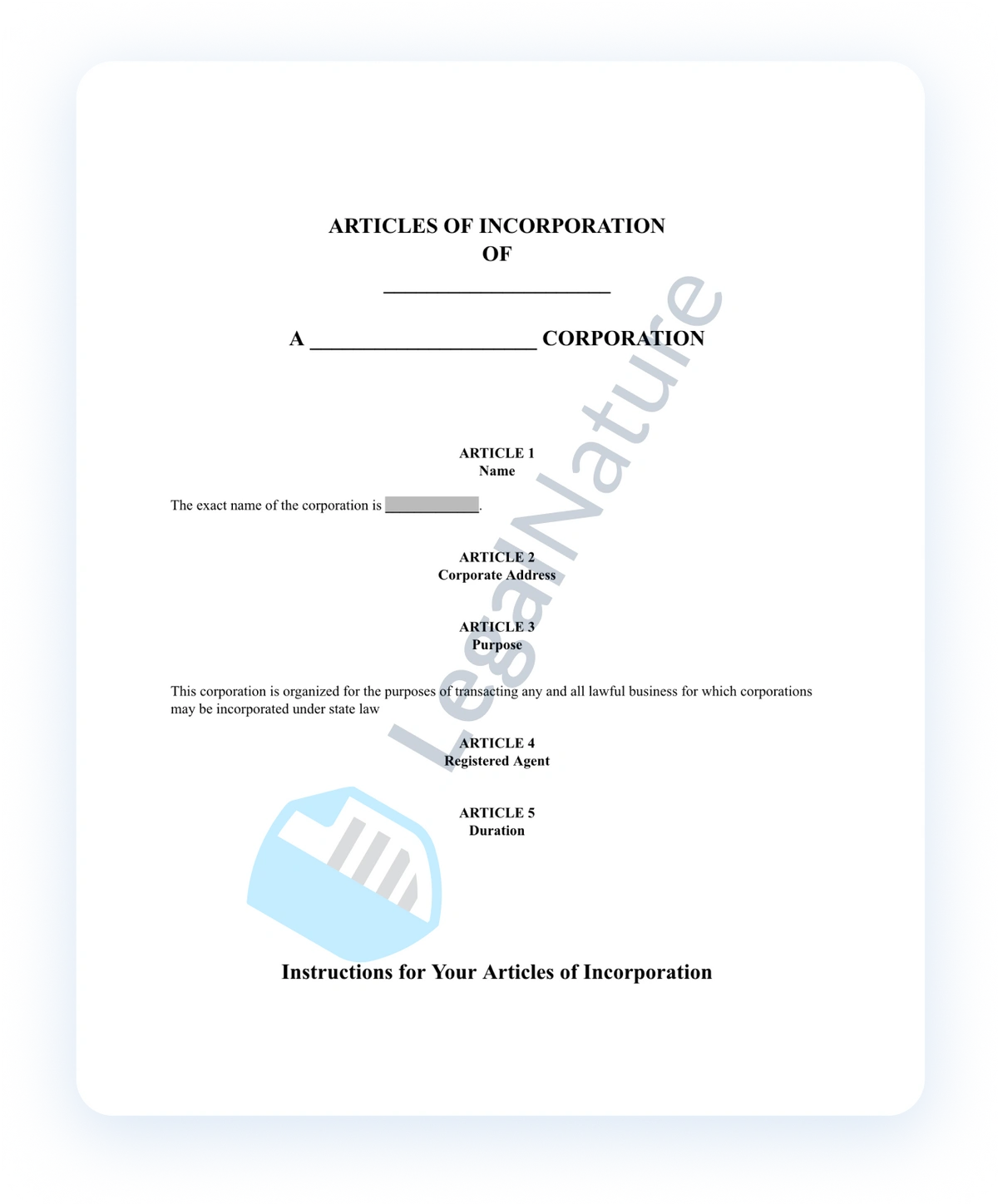
Articles of Incorporation Register your corporation in your state. LegalNature's intuitive forms are easy to use and compliant in all fifty states and the District of Columbia.
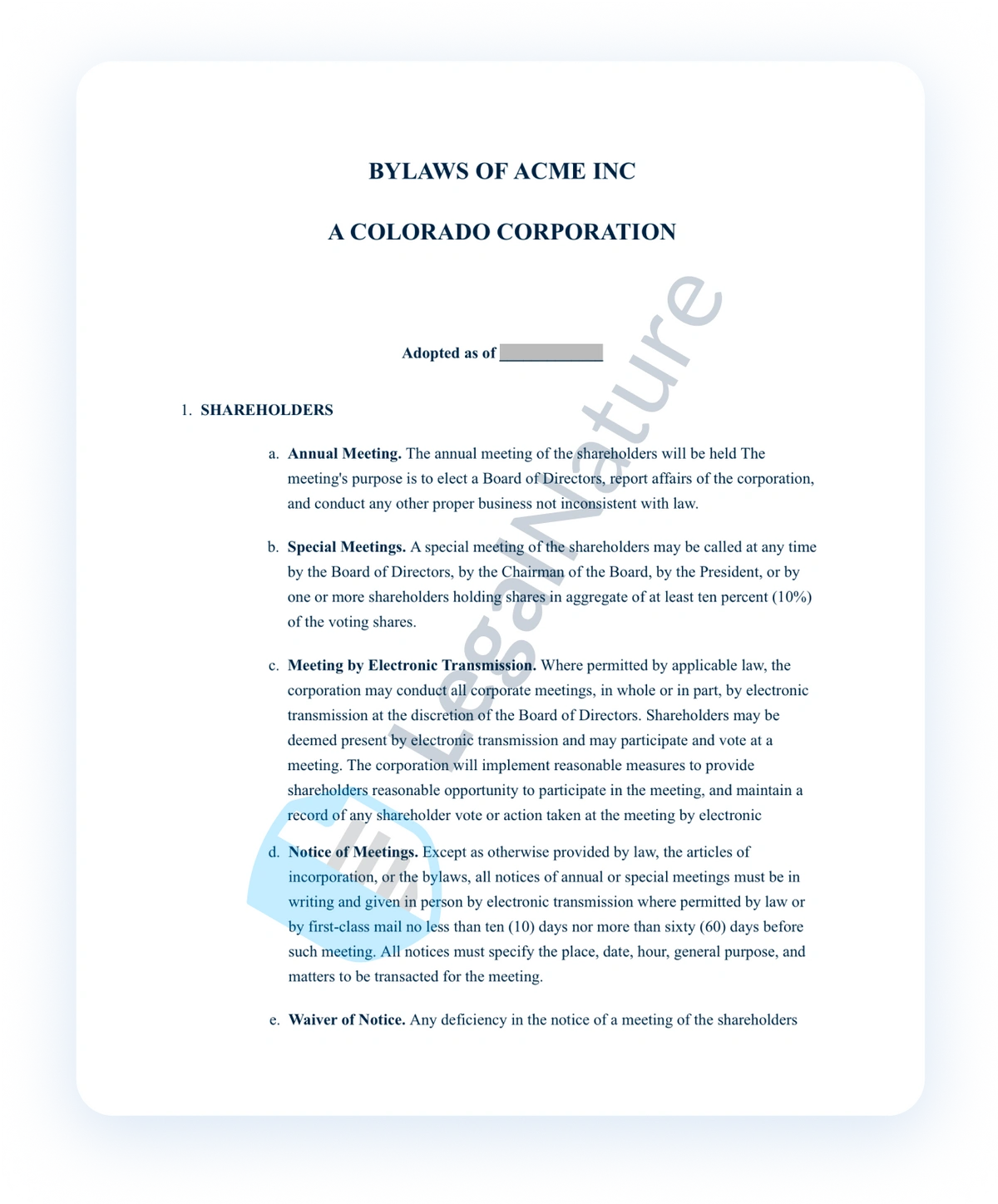
Corporate Bylaws Corporate bylaws are a set of rules and procedures used to determine how a C corp, S corp, or nonprofit will be run.
Create a corporate resolution in your state
When to use a corporate resolution
Generally, most routine actions do not require a formal resolution, but a corporate resolution should be used whenever a corporation or its board of directors needs to formally document and authorize significant business decisions or actions, especially in various circumstances where proper documentation is essential. This is particularly important for companies with multiple shareholders or those organized as a limited liability company (LLC), as resolutions help clarify decision-making authority and protect personal assets.
- Major Decisions: Examples include amending bylaws, adopting new bylaws, issuing company shares, authorizing debt or securities transactions, mergers, acquisitions, real estate purchases, and executive appointments.
- Delegating Authority: Authorizing officers to open bank accounts, withdraw money, write checks, sign contracts, or acquire loans on the company’s behalf.
- Voting and Meetings: Approving resolutions through voting by the board or shareholders during meetings and board meetings, ensuring that all major actions are properly authorized and recorded.
- Record Keeping: These resolutions are included in board meeting minutes, offering a paper trail for legal and audit purposes.
How to create your corporate resolution
Gather Information
Collect the business's information and the matter that is to be addressed by the corporate resolution, including the date the resolution was adopted and the specific means of adoption.
Answer Questions in Our Online Form
Our intuitive online form will ask you questions regarding your corporate resolution and fill out your document for you.
Review and Sign
It is always important to read your document thoroughly to ensure it matches your needs and is free of errors and omissions. After completing the questionnaire, you can make textual changes to your document by downloading it in Microsoft Word. If no changes are needed, you can simply download the PDF version and sign. All required parties should review and sign the document in compliance with any specific company bylaws.
Distribute and Store Copies
At a minimum, all parties who sign the document should receive a copy once it is fully executed (everyone has signed). Other interested parties may need or want copies as well. Be sure to store your copy in a safe location. It is a good idea to keep both a physical and electronic copy.
Why create a corporate resolution?
Corporate resolutions help ensure compliance with corporate policies, rules, regulations, and tax laws. Maintaining corporate records and keeping them separate from personal records is essential for legal protection and operational clarity. Access to corporate records is controlled, and these records may be reviewed by regulators or shareholders. Resolutions must be in writing, include proper signatures, and are often documented using a standardized form. For example, a corporate resolution may authorize opening a new bank account or approving a loan, depending on the circumstances and after determining the best course of action in the interest of the company.
- Legal protection: Resolutions offer evidence that an action was properly approved, helping maintain the corporate veil and liability protections.
- Compliance and record-keeping: Regulatory agencies, courts, and auditors may request proof of corporate decisions; resolutions provide this documentation.
- Transparency and accountability: Shareholders and stakeholders benefit from a clear trail of board actions.
Corporate resolutions are essential for any major or atypical decision affecting a company, ensuring legality, organization, and proper documentation for future review or compliance.

Why choose LegalNature?
Corporate Resolution Help Guide
Use a corporate resolution (called a "company resolution" for an LLC) to formally record the important binding decisions of a corporation's directors, officers, managers, or owners. A good corporate resolution is customizable to anticipate any resolutions the business's decision-makers may pass. The following guide provides helpful explanations of the more common resolutions your business may encounter in its lifespan.
Entity Types
For-profit and nonprofit corporations must regularly use corporate resolutions in order to meet required formalities required by state law. Although LLCs are not required to use corporate resolutions, they are still recommended to do so to document actions taken and votes decided at member meetings. Banks, investors, and other parties that work with the company will often request or require that they see company resolutions to gain a transparent view of company decisions.
Business Information
Enter the business's name exactly as it appears on your articles of incorporation or articles of organization filed, or to be filed, with the state.
Resolution Maker
Depending on the type of entity, resolutions are created by the shareholders, board of directors, members, or board of managers. Indicate which type of party will be creating this resolution.
Resolution Adoption
Based on the rules contained in your company’s articles of incorporation, shareholder agreement, corporate bylaws, or LLC operating agreement, you will select how the resolution is being passed.
- The resolution could be passed at a meeting that meets quorum. This is where the minimum number of decision-makers that must be present for the meeting to go forward are present, and a sufficient number of the decision-makers voted in favor of the resolutions.
- The resolution could be passed by necessary written consent. This is where a meeting is not necessary because a sufficient number of decision-makers consented in writing to approve the resolution.
- The resolution could be passed by unanimous written consent. This is where a meeting is not necessary because every decision-maker consented in writing to approve the resolution.
Adoption Date
Next, include the date that the resolution is being adopted by the company. Normally, this is the date that the meeting occurs. When a resolution is being passed by written consent, then the adoption date will be the date that the decision-makers finish providing their votes.
Resolution: Open a Bank Account
Nearly every business will need a bank account, and this resolution concisely enables the chief financial officer to authorize opening a bank account with a reputable bank for the company's sole use and benefit.
Resolution: Borrow Capital
When borrowing capital, banks frequently require proof that the company authorizes the loan. A resolution from the company stating consent to borrow capital with certain dollar and collateral limits will satisfy the bank that the company and their officers or representatives have the authority to engage the bank and seek out a loan.
Resolution: Amend Documents
A company's foundational documents often require a high standard of approval by the company's ultimate decision-makers before these documents can be changed or amended. To make changes to the bylaws, charter, shareholder agreement, or operating agreement, select the appropriate document to be amended and write out the specific section to be changed, replaced, or eliminated.
Resolution: Approve Annual Budget
It is best practice for a company's annual budget to be approved through a corporate resolution. Here, the decision-makers review the company financials from the previous year and approve the estimated budget for the coming year. To complete this section, insert the start and end date of your company's fiscal year.
Additionally, it is important to remember that the approved budget plan should be attached to the resolution and filed with the company records.
Resolution: Commence or Defend Lawsuit
This resolution authorizes the company's officers to either 1) start a new lawsuit against a third party that has wronged the company, or 2) defend an existing lawsuit from a third party alleging that the company committed certain wrongdoings. The resolution should include some general terms to reference the nature of the legal dispute and the parties involved. The resolution also gives the president or chief executive officer the authority to reasonably settle the dispute.
Resolution: Declare Dividend Distribution
(For-Profit Corporations Only)
To declare a dividend distribution to its shareholders, the corporation only needs to provide the distribution type, the dollar amount per share, and the classes of shares affected by this resolution. The corporation should also establish a "record date," which is the cut-off date to determine the shareholders eligible to receive the dividend distribution.
Resolution: Appointment of Directors/Officers/Managers
Use this resolution to appoint directors, officers, and managers to their respective positions within the company. These new appointments will begin immediately until their successors are elected, they resign voluntarily, or they are removed from the position by the company.
Resolution: Hire an Employee
This resolution allows the company officers to engage in the hiring of a specific employee and sets the parameters of the employment offer. The officers cannot hire an employee for more than the resolution's maximum dollar limit. The employee will receive whatever standard benefits are offered to other employees unless otherwise noted in this section.
Resolution: Lease or Purchase Certain Assets
For larger ticket items, a company and its financiers will often require the decision-makers to authorize the expenditure before the lease or purchase is made. This section identifies these leases or purchases in order to specifically authorize the officers to procure these items. Additionally, it is important to remember that the lease or purchase agreement, if available, should be attached to the resolution and filed with the company records.
Resolution: Negotiate a Contract
This resolution authorizes the company officers to enter into negotiations with a third party. A resolution is usually reserved for large or long-term contracts. It is not necessary for the officers to gain approval from the company decision-makers for smaller negotiations that the company may encounter on a daily basis.
Resolution: Obtain License or Government Approval
This resolution authorizes the company officers to pursue all licenses or government approvals that are specified here. This can also serve as verification to third parties that the company authorizes all actions relating to the procurement of these licenses and approvals.
Resolution: Ratify Prior Acts
This resolution allows the decision-makers to authorize any prior acts or decisions made by people who report to the decision-makers. For example, this resolution allows the shareholders to ratify acts done by the board of directors and any officers after careful consideration of the directors' and officers' actions and decisions.
Resolution: Retain a Specialist
This resolution authorizes the company to hire a specialist at a reasonable market rate as approved by the chief financial officer. These specialists may include accountants, brokers, attorneys, consultants, and more.
Resolution: Sell Business Equipment, a Vehicle, or Other Assets
This resolution identifies assets the company wishes to sell and the intended buyer. It is important to remember that the sales agreement, if available, should be attached to the resolution and filed with the company records.
Resolution: Terminate a Specific Contract/Employee/Officer/Director/Lease
This resolution formally approves the termination of a specific contract, employee, officer, director, or lease. The termination may occur immediately or on a specified date.
Resolution: Other
This resolution allows you to add any additional resolution passed by the company, if applicable.
Certification
When a company certifies a resolution, it means that an officer has affirmed that the resolution is correct as written and was validly adopted. Banks and other organizations often require certification in order to open accounts or transact business. Resolutions are commonly certified by the company secretary or chief executive officer.
Frequently asked questions
What is a corporate resolution?
A corporate resolution is a corporate action that will be voted on or has been voted on at a meeting of the board of directors or shareholders for a corporation. A corporate resolution can also be used by LLCs and nonprofits.
What is a certified corporate resolution?
A certified corporate resolution is a resolution made at a directors' or shareholders' meeting that has been approved by the secretary and president of the corporation. This type of resolution is useful if a bank or other external organization requires authentication to permit specific actions or powers, such as the authority to sign documents on behalf of the corporation.
What are the common types of corporate resolutions?
The common types of corporate resolutions include the following:
- Resolution to amend documents
- Resolution to approve annual budget
- Resolution to borrow capital
- Resolution to commence or defend lawsuits
- Resolution to declare dividend distribution
- Resolution to appoint or hire employees and officers
- Resolution to lease or purchase assets
- Resolution to negotiate contracts
- Resolution to open a bank account
What is the difference between corporate resolutions and corporate minutes?
A resolution is written documentation describing an action authorized by the board of directors or shareholders of a company. The minutes are a written document that describes items discussed by the directors or shareholders during a meeting, including actions taken and resolutions passed.
What is the difference between a directors' resolution and shareholders' resolution?
A directors' resolution is used by the board of directors in a corporation to document decisions and actions (typically) in place of a directors' meeting, while a shareholder's resolution is used by shareholders in a corporation to propose amendments, decisions, or changes to the corporation at a shareholder meeting.
Create your corporate resolution in minutes
Complete our form
;fill-opacity:1;'/%3e%3cpath%20fill-rule='evenodd'%20clip-rule='evenodd'%20d='M7.17816%205.46484C8.48591%205.46484%209.81742%206.23165%2011.1727%207.76529C10.8517%208.08628%2010.6467%208.28838%2010.5575%208.3716C10.4683%208.45482%2010.2514%208.6391%209.90659%208.92442C9.56182%209.20975%209.28244%209.40591%209.06844%209.51291C8.85445%209.6199%208.5721%209.73285%208.22138%209.85173C7.87067%209.97062%207.52293%2010.0301%207.17816%2010.0301C6.75017%2010.0301%206.35785%209.97656%206.00119%209.86957C5.64453%209.76257%205.28788%209.5783%204.93122%209.31675C4.57456%209.0552%204.29518%208.83229%204.09307%208.64801C3.89096%208.46374%203.58781%208.16355%203.18359%207.74745C3.95636%206.97469%204.64291%206.40107%205.24329%206.02658C5.84367%205.65209%206.48862%205.46484%207.17816%205.46484ZM7.17816%209.37024C7.61804%209.37024%207.9955%209.20975%208.31055%208.88876C8.6256%208.56776%208.78312%208.18733%208.78312%207.74745C8.78312%207.30757%208.6256%206.92714%208.31055%206.60615C7.9955%206.28516%207.61804%206.12466%207.17816%206.12466C6.73828%206.12466%206.36082%206.28516%206.04577%206.60615C5.73072%206.92714%205.5732%207.30757%205.5732%207.74745C5.5732%208.18733%205.73072%208.56776%206.04577%208.88876C6.36082%209.20975%206.73828%209.37024%207.17816%209.37024ZM7.17816%207.1768C7.17816%207.34324%207.23166%207.47996%207.33865%207.58696C7.44565%207.69395%207.58237%207.74745%207.74881%207.74745C7.8677%207.74745%207.98658%207.70584%208.10547%207.62262V7.74745C8.10547%208.009%208.01631%208.23191%207.83798%208.41619C7.65965%208.60046%207.43971%208.6926%207.17816%208.6926C6.91661%208.6926%206.69667%208.60046%206.51834%208.41619C6.34001%208.23191%206.25085%208.009%206.25085%207.74745C6.25085%207.4859%206.34001%207.26299%206.51834%207.07872C6.69667%206.89444%206.91661%206.80231%207.17816%206.80231H7.32082C7.22571%206.9212%207.17816%207.04603%207.17816%207.1768Z'%20fill='white'%20style='fill:white;fill-opacity:1;'/%3e%3c/svg%3e)
Preview and download your document
;fill-opacity:1;'/%3e%3cg%20clip-path='url(%23clip0_10486_8655)'%3e%3cpath%20d='M10.8931%205.49519C10.8004%205.45343%2010.6879%205.48908%2010.6427%205.57565L10.4595%205.92398L10.3128%205.85879L10.5058%205.49212L10.5069%205.48906C10.508%205.48703%2010.5091%205.48397%2010.5103%205.48194C10.54%205.4137%2010.5743%205.33324%2010.5864%205.24258C10.6239%204.97267%2010.5125%204.68749%2010.2874%204.47869C10.0733%204.28007%209.74562%204.16804%209.43445%204.18534C9.36934%204.18942%209.29984%204.20062%209.22812%204.21998C9.11446%204.25053%209.00302%204.30349%208.8982%204.37785C8.82316%204.4308%208.71833%204.52146%208.64661%204.64877L8.64551%204.65184L8.64441%204.65387L7.9603%205.95657C7.95698%205.96166%207.95369%205.96675%207.95037%205.97286C7.94705%205.97795%207.94485%205.98406%207.94265%205.99017L6.17057%209.36151C6.14408%209.41244%206.13085%209.46947%206.13305%209.5265V9.52752L6.17277%2010.6143C6.17718%2010.7202%206.22022%2010.819%206.29194%2010.8964L6.18712%2011.0919C6.14078%2011.1775%206.1794%2011.2814%206.27207%2011.3242C6.29856%2011.3364%206.32724%2011.3425%206.35483%2011.3425C6.42435%2011.3425%206.49056%2011.3069%206.52366%2011.2458L6.62516%2011.0553C6.64061%2011.0563%206.65495%2011.0573%206.6704%2011.0573C6.77412%2011.0573%206.87673%2011.0278%206.9628%2010.9687L7.91392%2010.325C7.93379%2010.3118%207.95254%2010.2955%207.96909%2010.2792C7.97241%2010.2761%207.97461%2010.2731%207.97793%2010.27C7.9989%2010.2476%208.01655%2010.2222%208.0309%2010.1957L10.1483%206.16942L10.2951%206.23461L9.35169%208.02823C9.30645%208.11379%209.34507%208.21768%209.43886%208.25943C9.46535%208.27165%209.49293%208.27674%209.52052%208.27674C9.59004%208.27674%209.65735%208.24109%209.68935%208.17896L10.7023%206.25293C10.7078%206.24581%2010.7133%206.23766%2010.7177%206.2295C10.7222%206.22134%2010.7244%206.21422%2010.7277%206.20606L10.9804%205.72533C11.0255%205.64082%2010.9858%205.53694%2010.8931%205.49519ZM6.73994%2010.6907C6.70574%2010.7131%206.6627%2010.7182%206.62408%2010.7049C6.61857%2010.7019%206.61305%2010.6988%206.60643%2010.6958C6.60312%2010.6948%206.60092%2010.6937%206.5976%2010.6927C6.5656%2010.6723%206.54575%2010.6398%206.54463%2010.6041L6.51814%209.89623C6.76641%2010.0745%207.05219%2010.2028%207.35673%2010.2741L6.73994%2010.6907Z'%20fill='white'%20style='fill:white;fill-opacity:1;'/%3e%3cpath%20d='M5.59896%2011.03C5.55151%2011.029%205.49634%2011.03%205.43897%2011.03C5.13885%2011.0331%204.57941%2011.0382%204.40067%2010.8538C4.36976%2010.8222%204.33005%2010.7652%204.3444%2010.647C4.38634%2010.314%204.58935%209.96362%204.76811%209.65499L4.79789%209.60305C4.85638%209.50221%204.91707%209.40036%204.97664%209.30056C5.14766%209.01537%205.32421%208.72%205.46433%208.40935C5.56806%208.18018%205.62542%207.96426%205.63536%207.7697C5.64859%207.50897%205.57799%207.28183%205.42571%207.09441C5.24365%206.86932%204.97774%206.70431%204.61361%206.58821C4.31128%206.49145%203.97806%206.44154%203.68455%206.39672C3.55215%206.37635%203.42635%206.35801%203.3105%206.33561C3.20899%206.31626%203.10969%206.37737%203.08982%206.47108C3.06885%206.56478%203.13505%206.65645%203.23658%206.67479C3.36015%206.69822%203.48926%206.71756%203.62497%206.73793C4.18219%206.82248%204.81444%206.91719%205.1256%207.30118C5.30986%207.52832%205.30766%207.85628%205.11788%208.2759C4.98547%208.56925%204.81444%208.85545%204.64783%209.13248C4.58825%209.23231%204.52646%209.33619%204.46687%209.43905L4.43709%209.48998C4.2418%209.82609%204.02111%2010.207%203.97146%2010.6053C3.9472%2010.7957%203.99795%2010.9567%204.12152%2011.084C4.38082%2011.3498%204.8939%2011.3763%205.29223%2011.3763C5.34408%2011.3763%205.39485%2011.3763%205.44229%2011.3753C5.49855%2011.3753%205.55043%2011.3743%205.59456%2011.3753C5.59566%2011.3753%205.59566%2011.3753%205.59676%2011.3753C5.69939%2011.3753%205.78324%2011.2989%205.78434%2011.2041C5.78544%2011.1105%205.70266%2011.031%205.59896%2011.03Z'%20fill='white'%20style='fill:white;fill-opacity:1;'/%3e%3c/g%3e%3cdefs%3e%3cclipPath%20id='clip0_10486_8655'%3e%3crect%20width='7.91304'%20height='7.30435'%20fill='white'%20style='fill:white;fill-opacity:1;'%20transform='translate(3.08594%204.12891)'/%3e%3c/clipPath%3e%3c/defs%3e%3c/svg%3e)
Review and sign your document
